When the steamship Inveralt grounded near the eastern end of Pictou Island on 4 August 1884, the event began as a maritime salvage problem. Months later it became a tragedy. The story is remembered not only for the ship, but for the people who lost their lives and those who responded from the island.
One grounding. Months of salvage. A fatal rescue emergency.
The Inveralt story unfolded in three phases. Keeping them separate explains why an August grounding became a November disaster—and why the Island’s losses matter alongside its rescuers.
4 August 1884 — Grounding. The steamship went aground at East Point in thick fog. Attempts to free it failed.
August–November — Salvage. Wrecking work continued after the grounding; the fatal boat disaster was a later event.
15 November 1884 — Deaths and rescue. A lifeboat carrying eleven wreckers overturned in a northerly gale. Eight deaths and three survivors are strongly supported; Island boats answered the emergency.
The reports and the people remembered: the clipping reports eight deaths but appears to list nine names. Government records document the awards, though not every recipient can be matched with certainty to an individual rescue participant. The later life-saving station and the 1893 barque Stanley rescue are separate histories.
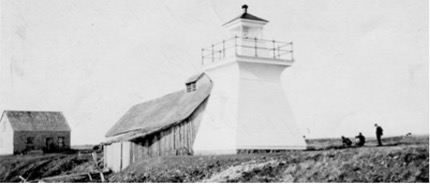
Island lighthouse context; not a photograph of the Inveralt rescue. PIHS collection
Grounded at East Point
The Inveralt was a British steamship of 841 tons, registered at Liverpool. A contemporary Canadian government report states that, while travelling from Montreal to Pictou, the vessel went aground on the East Point of Pictou Island on August 4, 1884. The night was described as very thick and foggy.
The Department ordered an investigation. It found that because the master did not know the locality, he should not have continued in thick weather without a pilot. The report says there was no cargo aboard and that several attempts by a wrecking company to free the steamer were unsuccessful.
Eight men die during the salvage
James W. Hogg acquired the salvage rights, and work continued into November. On 15 November 1884, eleven wreckers tried to come ashore in a lifeboat during a northerly gale. The boat overturned on the reef and eight men died.
The newspaper clipping reports eight deaths, but its final list appears to contain nine names. The list therefore cannot be treated as a confirmed roll of the dead. The older Hugh MacFarlane of Pictou Island (c.1859/60–15 November 1884) was among those lost; he is not Hugh “Hughie” MacFarlane, born in 1917 to Allan and Annie. Lewis Lawrence had been an Island resident for some time and had married into the Patterson family.
The date of 15 November 1884 is supported by a report published the next day, which says the disaster occurred “yesterday,” and by the date engraved on a government-awarded watch. MacCallum’s later account gives 17 November.
Island boats answer the emergency
William Allard first put out alone in a small dory but lost an oar. James Currie and another Islander then launched a larger boat and reached the overturned lifeboat. A second Island party led by James Hogg pursued the boats in an open sailboat. Survivors and rescuers were carried away from the Island by the gale; the rescue party ultimately reached the mainland and the lifeboat crew landed at Big Island the following morning.
MacCallum’s account says remains from the wreck came ashore near the East End and were buried on the Hogg farm. Erosion later placed the reported burial site beneath the water of the East End cove.
The island crew remembered
Government records cited by MacCallum list silver watches for Captain James Currie, W. Wales, William Allard, Daniel McCallum, and Andrew MacFarlane, and a binocular glass for James W. Hogg. One surviving watch records the government’s recognition of Daniel MacCallum’s efforts. A Pictou County Council proposal to fund an East End monument was introduced in January 1885 but failed for want of a seconder.
Andrew MacFarlane, born on Pictou Island in 1855, was appointed East Lighthouse keeper on 8 June 1892 according to federal personnel evidence. It is not yet known when his service ended. His life connects the rescue with the later history of the East Lighthouse.
Why this matters
The Inveralt story cannot be reduced to a successful rescue. A summer grounding became a months-long salvage operation and then an eight-death disaster with direct Island losses. The rescue and government recognition matter, but they follow—not replace—the men who died.
New York Times, November 18, 1884, “Eight Wreckers Drowned,” reproduced in MacCallum, p. 170. Contemporary account of the boat disaster, victims, and rescue attempts.
John D. MacCallum letter to The Pictou Advocate, based on conversations with lifeboat crew member Andrew MacFarlane, reproduced in MacCallum, pp. 171–172. Community testimony for the salvage, Island connections, rescue, awards, and burials.