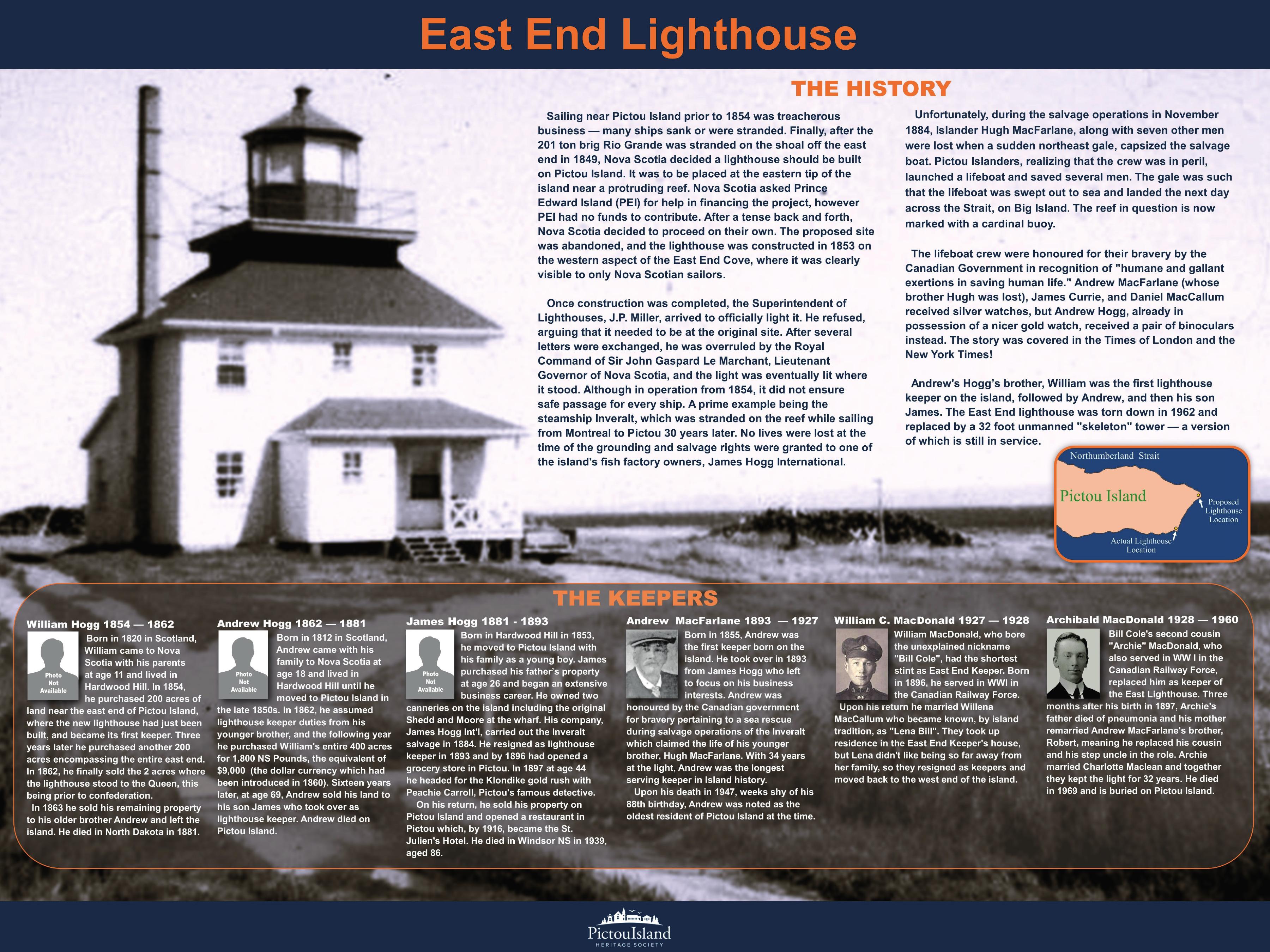
Pictou Island’s first lighthouse answered the hazards facing ships in Northumberland Strait. Its history is also the history of the people who lived and worked at the eastern end, the dispute over its location, and its connections with the Inveralt rescue. Keeping the light meant responsibility in storms, ice and ordinary nights alike.
Pictou Island’s first lighthouse, its disputed location, keepers and connection to the Inveralt rescue.
THE HISTORY
Ships faced dangerous shoals around Pictou Island long before its first lighthouse. Kenneth MacCallum names the brig Rio Grande in a reported 1849 loss, but contemporary verification remains open. Calls for a lighthouse began before 1849; it is not known whether the reported loss led to its construction. Nova Scotia and Prince Edward Island discussed sharing the cost, but the surviving records do not prove that PEI’s decision not to participate determined the final location. Nova Scotia proceeded, and the lighthouse was constructed in 1853 on the western aspect of the East End Cove. The published extract of Commander G. J. Napier’s letter of 11 September 1854 explicitly includes Pictou Island among three lights first lit that year. It supports 1854 as the lighting year, although an 1876 official light list instead gives 1853. The conflicting listing and exact first-light day remain unresolved.
A notice reprinted from the Eastern Chronicle in the Newfoundland Express of 19 November 1853 described the new East End lighthouse as nearly complete, named William Hogg as its appointed keeper and anticipated lighting within two or three weeks. The notice described what was expected while construction was nearly complete. Napier’s September 1854 letter indicates that the light was operating by then.
Kenneth MacCallum reproduced an account of a dispute over the new lighthouse in 1854. Superintendent of Lighthouses J. P. Miller objected to its location and refused to commission the light until the government ordered him to proceed. The exact day the light first shone remains uncertain. The later Inveralt wreck and rescue showed that a lighthouse could not remove every danger from these waters.
The Inveralt salvage disaster of 15 November 1884 cost eight lives and brought Island crews into a rescue effort. Andrew MacFarlane appears in the government recognition record and later became East Lighthouse keeper. Not every person named in the rescue can be identified with certainty. Read the grounding, salvage disaster and rescue in the Inveralt article.
William Hogg, Andrew H. Hogg and James W. Hogg are reported in the East keeper sequence, followed by Andrew MacFarlane, whose appointment date of 8 June 1892 is confirmed. A published local recollection describes a Coast Guard supply ship offshore in 1959 or 1960 and approximately 55 fuel drums being carried up the cliff to the East End lighthouse; the year, quantity and details remain uncertain and attributed. Around 1962 the staffed East station gave way to an unattended skeletal aid; the exact federal automation/removal record remains open.
Completed PIHS East Lighthouse panel, including its historical illustrations. Pictou Island Heritage Society interpretive panel
Keeping an oil light burning
The lighthouse was a working system of lamps, reflectors, fuel and daily care. A report dated 15 December 1857 describes William Hogg’s station as a white square lighthouse and dwelling showing a fixed white light, with six catoptric lamps and reflectors. The reflectors directed the lamps’ light outward toward passing vessels.
The Marine report for 1874 gives a more detailed view of the equipment: two circular-burner lamps with eighteen-inch reflectors and four A lamps with twelve-inch reflectors. It records annual oil consumption of about 240 gallons. The 410 gallons also listed in the report was fuel held in stock, a different quantity from the oil used during a year.
These records bring the keeper’s work into the story alongside the names and appointment dates. The fuel had to reach the station, and the equipment had to produce a dependable visible light. Later memories of drums hauled up the cliff belong to that longer history of supplying a lighthouse, though their details remain attributed recollection.
The keepers
William Hogg
appointed by November 1853 — 1862 reported
The station was nearly complete and William Hogg was appointed by November 1853. Napier’s September 1854 letter identifies 1854 as the lighting year; an 1876 list instead prints 1853. The exact first-light day remains open.
Andrew Hogg
1862 — 1881
Born in 1812 in Scotland, Andrew came with his family to Nova Scotia at age 18 and lived in Hardwood Hill until the late 1850s. In 1862, he assumed lighthouse keeper duties from his younger brother, and the following year he purchased William’s entire 400 acres for 1,800 NS Pounds, the equivalent of $9,000 (the dollar currency which had been introduced in 1860). Local history reports that Andrew later sold his land to his son James, who succeeded him as keeper. The date of the land sale remains uncertain. The reported 1881 endpoint refers to Andrew’s service as keeper. Andrew died on Pictou Island.
James Hogg
1881 — 1892 reported
The 1881 Marine report records James Wm. Hogg appointed by an Order in Council of 1 July 1881, replacing Andrew H. Hogg, superannuated. The published return does not give his first day on duty, and his exact resignation date remains unknown.
Andrew MacFarlane
appointed 8 June 1892 — 1927 reported
Federal records give Andrew MacFarlane’s appointment date as 8 June 1892. The end of his service at the East Lighthouse remains uncertain, as do some individual identifications in the rescue.
William C. MacDonald
1927 — 1928
William MacDonald, who bore the unexplained nickname “Bill Cole”, had the shortest stint as East End Keeper. Born in 1896, he served in WWI in the Canadian Railway Force. Upon his return he married Willena MacCallum who became known, by island tradition, as “Lena Bill”. They took up residence in the East End Keeper’s house, but Lena didn’t like being so far away from her family, so they resigned as keepers and moved back to the west end of the island.
Fire, repairs and a keeper’s retirement
The Marine report for 1876 preserves the keeper’s account of a lantern fire on the night of 19 April. He reported explosions near midnight and a fire brought under control in about twenty minutes. Lamps and glazing were destroyed and the lantern’s woodwork and metalwork damaged. The agency reported repairs and the light’s return to operation on 28 April. The account describes damage to the lantern, not the destruction of the whole lighthouse.
The fire narrative does not sign the keeper’s name. The same report’s accounts name Andrew Hogg as keeper and list $57.55 for lantern repairs after the fire, alongside salary and other work. That connects him strongly with the station, without proving the complete restoration cost or a technical cause of ignition.
A federal retirement return lists Andrew Hogg, lighthouse keeper at Pictou Island, with an annual allowance of $165.60 and an Order in Council dated 18 June 1881. The following fiscal account records twelve months of James Hogg’s keeper salary. The allowance order and replacement appointment give different administrative dates; neither establishes the exact day the keepers changed over.
Archibald MacDonald
1928 — c.1962 reported
Archie MacDonald is identified as the longtime twentieth-century East keeper. His full middle-name identification and the exact date the staffed station ended remain unconfirmed.
Sources
Pictou Island Heritage Society, East End Lighthouse interpretive panel; text credited to Lorne Matheson; federal lighthouse and personnel records.
Additional documentary sources
Nova Scotia lighthouse report dated 15 December 1857, Appendix 17, p.137, published in 1858; Department of Marine report for 1874, p.123, published in 1875. These reports describe the East station’s lighting equipment and fuel.
Sources and evidence notes
The 19 November 1853 Newfoundland Express, PDF page 2, reprints an Eastern Chronicle notice. The page was rendered and the notice visually inspected because its embedded text extraction was unreliable. The original Eastern Chronicle issue date is not shown in the reprint; expected lighting within two or three weeks is not a confirmed first-light day. The notice must not be used to imply an operating East light at the October 1853 Fairy Queen disaster.
The July 2026 Coast Guard amendments retain the East End aid as List of Lights No. 899.5, a square skeletal tower. This confirms the later aid’s identity, not the date of the original tower’s removal or the keeper’s departure. The reported c.1962 transition remains qualified; no new original automation instrument was recovered in this batch.
The fiscal 1886–87 Marine account records James W. Hogg receiving $106.55 for an addition to the Pictou Island dwelling. His twelve-month keeper salary was separately entered as $395, with $5 superannuation tax making a $400 payroll subtotal. The addition entry does not identify its builder or connect the work to the earlier stone house. A later 1891–92 salary-and-allowance account records J. W. Hogg at Pictou Island with $300.83, without specifying a period of duty. In this station and succession context, James W., J. W. and James Wm. identify James William Hogg; the account amount does not fix his handover date.