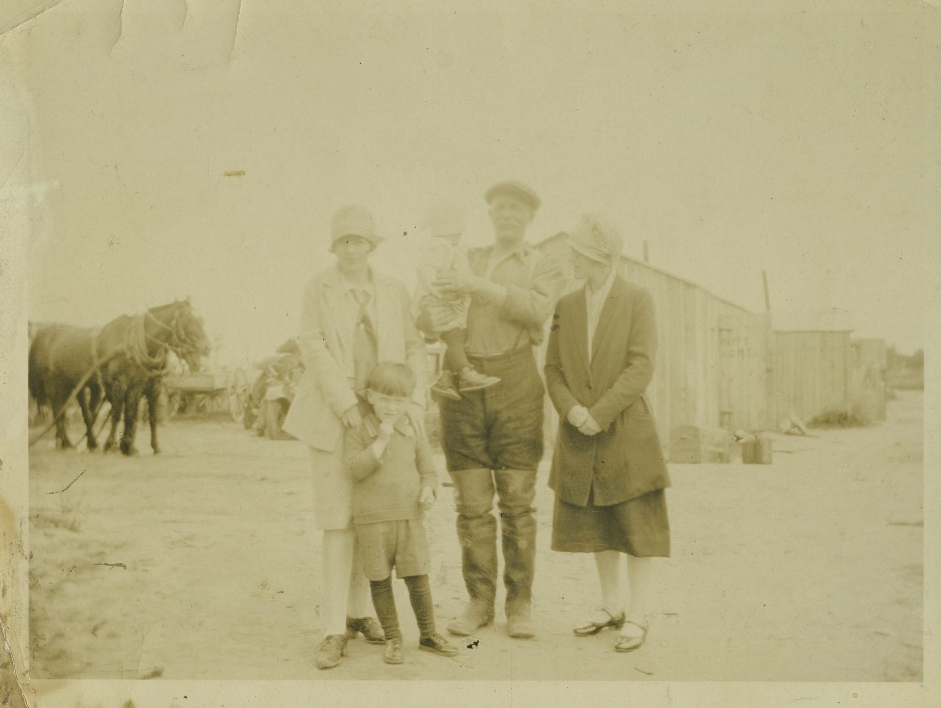
Group captioned Mae MacDonald, Happy Angus, Maggie Bell, Heck and Betty
Undated; before 18 March 1938 if the album’s Happy Angus identification is correct. Location unrecorded.
Contributed by Chris Stafford
View photograph, caption and connections → Virtual Museum


Article · Pictou Island history
Farming, fishing, household production and mainland supply in the Island’s agricultural history.
For generations, farming was part of Pictou Island’s daily work. A household with cows or sheep could also depend on the fishery, share labour with neighbours and buy necessities brought across the Strait. Farming was substantial, and its history connects fields, barns, kitchens, boats and mainland markets.
Heartz’s Pictou Advocate account of 16 April 1907 describes farming alongside fishing as ordinary Island work.
The early returns show cultivation becoming established. Haliburton’s account, published in 1829, reports 1827 Island figures of 59 residents and 116 cultivated acres, with wheat, other grain, potatoes, hay, cattle, sheep and swine. In 1838, the provincial return counted 119 people in 17 households. Fourteen household heads were recorded as farmers, two as carpenters and one as a blacksmith. These were occupations of household heads, not a count of every person’s work.
Deeds and wills offer glimpses of individual Island farms. In 1863, farmer Hugh McDonald conveyed the roughly fifty-acre eastern half of Lot 5 to mariner Robert McDonald for $2. The deed refers to a division plan made by surveyor Peter Crerar in 1830, though the original plan and the lot’s modern boundaries remain uncertain. It does not identify a particular building or establish how Hugh and Robert were related. Later wills describe farms, livestock, barns, tools and provisions for family members in the MacDonald, McDonald and Patterson families.
The registered assignment of 23 March 1857 transferred John McGregor’s legal and equitable interests in Pictou Island to Charles Twining, both Halifax barristers, in trust. It recites debts and advances of £250 and upwards and authorizes sales and deeds, with proceeds applied after expenses to the advances and interest. This was a security and trust transaction, not a purchase of the whole Island for £250.
On 1 June 1858, Charles Twining conveyed eastern-end Lot 26 to John McFarlane, described as a Pictou Island yeoman. The deed describes about 100 acres on Peter Crerar’s 1830 plan and reserves the public road. Its £2 10s is the balance of consideration, not the total price. The registered deed is Book 45, page 248. It does not establish that the buyer was John D. McFarlane or prove a later 1908 estate transfer to Robert.
Pictou Registry Book 43, pp. 296–297: 1857 trust assignment; continuation; Book 45, p. 248: 1858 Lot 26 deed. The original 1830 plan, earliest resident purchase and modern boundaries remain unresolved.
One family can be followed from a census household to the arrangements for a farm’s future. The 1871 return records Donald McDonald as a farmer, with Helen and John, Colin, Mary Ann, Hector and Jessie in the household. His will of 1896 names Helen as his wife and the same five people as his children. The matching names strongly connect the two records.[2][11]
Wills show how access to a house, animals and land could sustain relatives after a death. Hugh MacDonald’s will of 21 February 1887 gave his niece Agnes McCallum a cow. His sister Isabella received lifetime use of her house and an acre around it; his wife Christie received the remaining real estate and personal property, subject to the bequests and estate obligations. Christie was also appointed an executrix. Ownership, use and responsibility could be distributed among different members of a family.[1]
Donald McDonald’s will of 6 February 1896 divided his farm between sons John and Hector, using fifty-acre descriptions with a small adjustment for the occupied buildings. Hector could share the barn on the western side while the brothers agreed. If they disagreed, he was to give up that use and John was to meet half the expense of a barn for Hector. The provision anticipated a practical difficulty: dividing the land did not automatically provide each household with the buildings it needed.[2]
Donald’s wife Helen received lifetime use of the house, use of a cow, heifer, calf and six sheep, household furniture, and maintenance from the sons. Daughters Mary Ann and Jessie were offered a home while the house stood, they needed it and remained unmarried. The will laid out intended support; it does not tell us how those arrangements worked in practice.[2]
The will also records Colin’s absence abroad. Donald wrote that Colin had received his education, learned a trade and was then away in foreign lands. He left him one dollar if he came to claim it. The will mentions Colin’s education, a trade and his time abroad, though it does not name his trade or destination.[2]
Alexander McDonald’s 1897 will placed the western half of his farm and half the stock with his wife Maggie, with other family arrangements continuing until his infant son came of age. It also mentioned furniture, farming implements and support for an aged aunt. Malcolm Patterson’s 1898 will gave his wife Mary a life interest in his real and personal property, with the eastern and western farm halves to pass afterward to Charles Dan and Lauchlin. Neither document gives a complete inventory of the farm’s production.[3]
John McFarlane’s will of 11 May 1907 provides another variation. Allan was to receive the eastern fifty acres and barn access. John’s wife, unnamed in the will, was to have the western side during her lifetime; afterward it was to be offered for sale, with Allan receiving the first offer and the proceeds divided equally among the family. A will records an intended succession. Later deeds or estate accounts are needed to show what was actually transferred.[4]
Farm succession could also pass through women. Hugh McLean, who described himself as a Pictou Island farmer, made his will on 18 August 1910. He left his personal property to his wife Mary after debts and expenses, and his real estate to her for her lifetime, then to their daughter Annie Jane McLean. Mary was also appointed sole executrix. This records an intended succession through a widow and daughter; it does not identify acreage or prove the later transfer.[9]
Hay occupied more land than any other named field crop in both the 1931 and 1941 returns. That is consistent with a landscape supporting livestock as well as growing food for people. Crop acreage measures land use, however; it does not tell us how much feed was purchased, how productive each field was, or which household used it.[5]
The agricultural censuses show the scale of twentieth-century farming. In 1931, 36 occupiers reported 3,051 acres of occupied farm land and 880 acres of field crops. Hay dominated at 538 acres, alongside oats, potatoes, wheat, barley and roots. The tables also recorded horses, cattle, 418 sheep, 20 pigs and more than 1,200 hens and chickens. Seven acres belonged to the combined orchards-and-vineyards category, but no household or location can be assigned.
By 1941, farming remained substantial but several measures had declined: 33 operators occupied 2,878 acres, cultivated hay covered 492 acres, and livestock totals remained significant. The figures show farming had declined, though it remained part of Island life.
| Measure | 1931 | 1941 |
|---|---|---|
| Farm occupiers / operators | 36 | 33 |
| Occupied farm land | 3,051 acres | 2,878 acres |
| Cultivated hay | 538 acres | 492 acres |
| Potatoes | 50 acres | 26 acres |
| Horses | 36 | 27 |
| Sheep | 418 | 404 |
| Population reported on farms | 181 | 147 |
People living on farms were not all counted as farmers. Occupied farm land included woodland and other land beyond the cultivated fields. These Island totals cannot identify a particular family’s acreage or animals.[5]
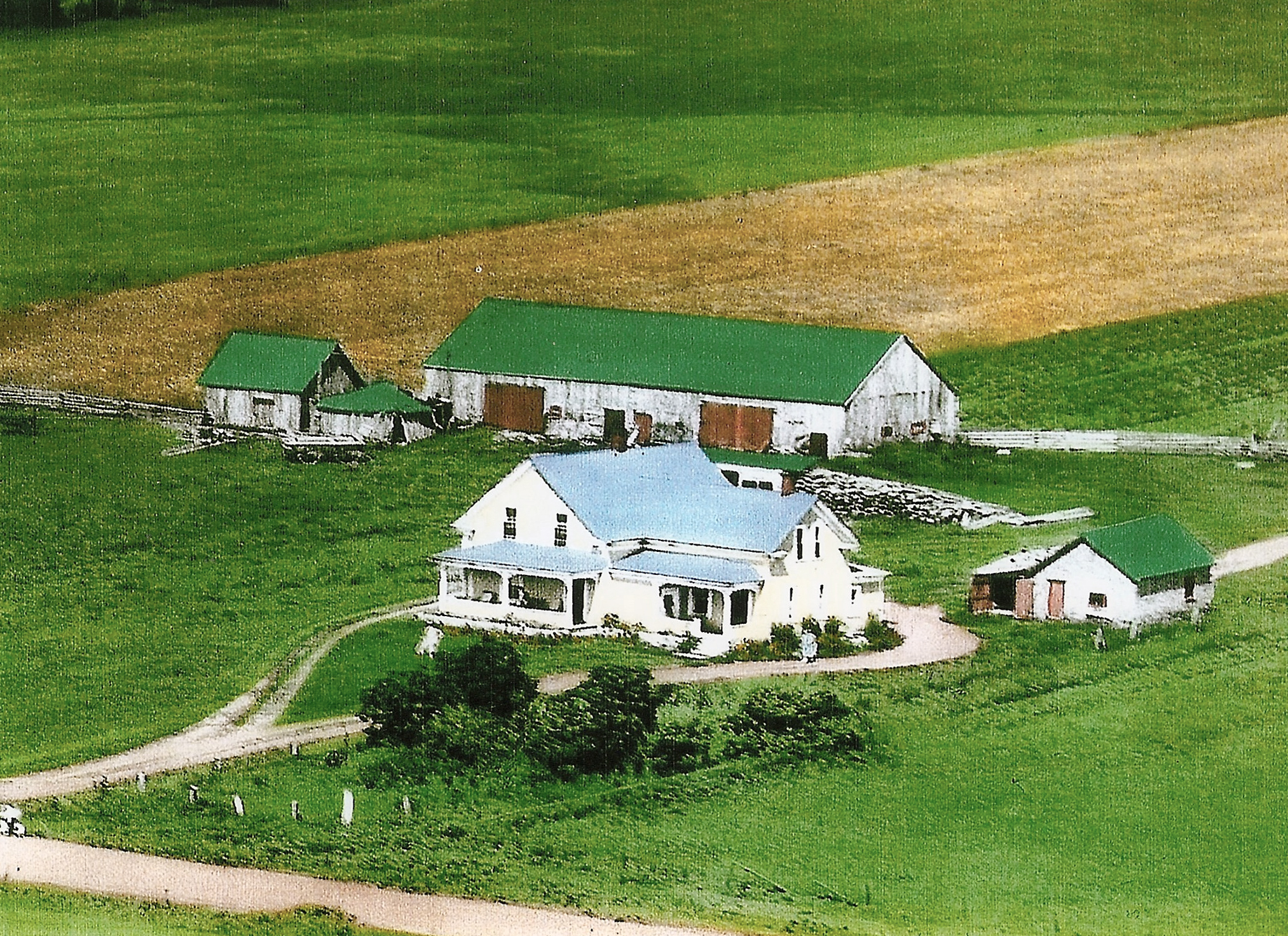
John Malcolm MacCallum’s account, preserved in Ruth Munro’s Pictou Island, recalls his father Charles’s large barn, lumber brought from Pictou and neighbours helping with the work. He remembered livestock and poultry and described Charles supporting the family through farming rather than fishing. His account reminds us that, although the Island had a mixed economy, not everyone both farmed and fished.[6]
Munro also describes meat, butter, wool and poultry being taken to Pictou, fruit and berry gathering or marketing, winter meat preservation and woodcutting. Her account connects farming with seasonal household work and exchange beyond the Island. It does not supply a complete set of sales accounts or prove that every farm produced the same goods.[6]
Household production could also bring in income. In her account of the MacCallum family, Munro describes Mrs. MacCallum knitting clothing for sale through Smith Grant’s dry-goods store in Pictou. She also records John Malcolm’s childhood memory of picking cranberries with his mother for shipment to the mainland. Her account shows how women and children contributed to household income, though it cannot tell us what every household earned.[6]
Munro describes food being smoked, salted or frozen, butter stored for periods when cows were not producing milk, and poultry retained for household use and the next season’s breeding. Supplies brought home included kerosene, flour, sugar, molasses and animal feed. Her picture of substantial household production therefore includes regular mainland purchases.[6]
Local production did not remove dependence on mainland supplies. Oral histories remember grain and hay imports alongside gardens, livestock, food preservation, shared haying and shared butchering. These memories describe particular households; families did not all work in the same way. Ward MacCallum’s winter grocery crossing is told in the iceboat article.
The census itself helps explain why a household’s work could exceed its recorded occupation. In 1871, enumerators could enter both of a person’s occupations, but were not required to do so; the choice depended on the importance the person attached to them. A single occupation in the census does not mean a person could not both farm and fish.[10]
The instructions also treated family work differently for men and women. A son working on his father’s farm could be entered as a farmer. Women and children were generally to receive a dash unless they had a distinct occupation beyond their share of household or family work. That omission does not demonstrate inactivity. Munro’s accounts of knitting and cranberry gathering help show contributions that a single occupation column could miss. The later 1941 farm-worker category also expressly excluded housework.[5][6][10]
Livestock transport has a memorable place in Munro’s book. She reproduces a Pictou Advocate story dated 2 July 1981 about a young Hereford bull brought to the Island aboard the Water Baby, identified as Cally MacCallum’s fishing boat. The report said an unnamed Island farmer had apparently bought the animal at the Truro cattle mart. After refusing the gangplank, it entered the water and reached the beach beside the wharf.[8]
The story connects an Island livestock purchase with a mainland market and transport by fishing boat. The reproduced report does not name the purchaser or establish the scale of farming then.[8]
The landscape changed gradually. Woodland within occupied farms rose from 1,403 acres in 1931 to 1,621 in 1941 while improved and crop acreage declined. Sherwood still described south-side open pasture in 1975, and later memories describe former fields returning to trees. The extent and timing of that landscape change have not been measured here.
Munro’s discussion of agricultural decline singles out Ernest Rankin as continuing the earlier farming way of life. That observation belongs to her account and its recollections; it does not supply a documented date for a final farm or establish that all other food production had ceased.[6]
Several things could change together: household labour, demand for produce, transport, the cost of supplies and opportunities for other work. Eric Ross’s 1987 study offers an interpretation involving markets, transportation and seasonal employment. These are explanations to examine alongside the records, rather than measured causes of each farm’s decline. The census establishes a change in reported farming; it cannot tell us why an individual family stopped cultivating a field.[7]
Island households combined farming, fishing, transport, preservation, purchased supplies and shared labour in proportions that changed over time.
Hugh McDonald to Robert McDonald, 15 September 1863, Pictou Registry Book 50, pp. 281–282; DGS 008621075, image 155. The original registered deed corrects the earlier reported folio 881 locator. Its plan reference is a later deed recital, not the original 1830 plan.
Hugh MacDonald will, HAGGIS 3101; Donald McDonald will, HAGGIS 3085; Alexander McDonald will, HAGGIS 2850; Malcolm Patterson will, HAGGIS 4200. Agricultural quantities come from the 1931 and 1941 Nova Scotia Census of Agriculture.
Early returns: Thomas C. Haliburton, An Historical and Statistical Account of Nova-Scotia, vol. II (1829), pp. 59–60, agricultural table; Nova Scotia Archives, 1838 Census Returns, RG 1, vol. 449, no. 166, Pictou Island records 24719–24735. The 1829 publication contains 1827 data. Evangeline Heartz, Pictou Advocate, 16 April 1907, supplies the contemporary mixed-work description.
Heartz’s 1907 account is contemporary qualitative evidence, not a measure of acreage, farm numbers or crop totals. The 1838 occupation labels do not establish what each family grew or that farming was their only work. Census farm acreage and crop categories describe reported land use; they must not be converted into household-level locations without further evidence. The 1931 combined orchards-and-vineyards category does not identify a particular vineyard. Oral histories describe individual household experiences, and the timing and extent of later field regrowth remain unmeasured.
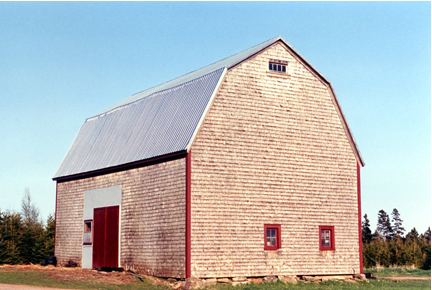
From the Museum’s shared Timeline; approximate dates and ranges retain their qualifications.
This farmyard group belongs to the family album. The horses and rural setting provide a subject connection; the location, farm and horse owners are unrecorded.
Undated; before 18 March 1938 if the album’s Happy Angus identification is correct. Location unrecorded.
Contributed by Chris Stafford
View photograph, caption and connections →