
Article · Pictou Island history
The Pictou Island Iceboat: Crossing Water and Ice
The surviving iceboat and the demanding winter journeys between water and ice.
The Pictou Island Iceboat: Crossing Water and Ice
A boat for water and ice
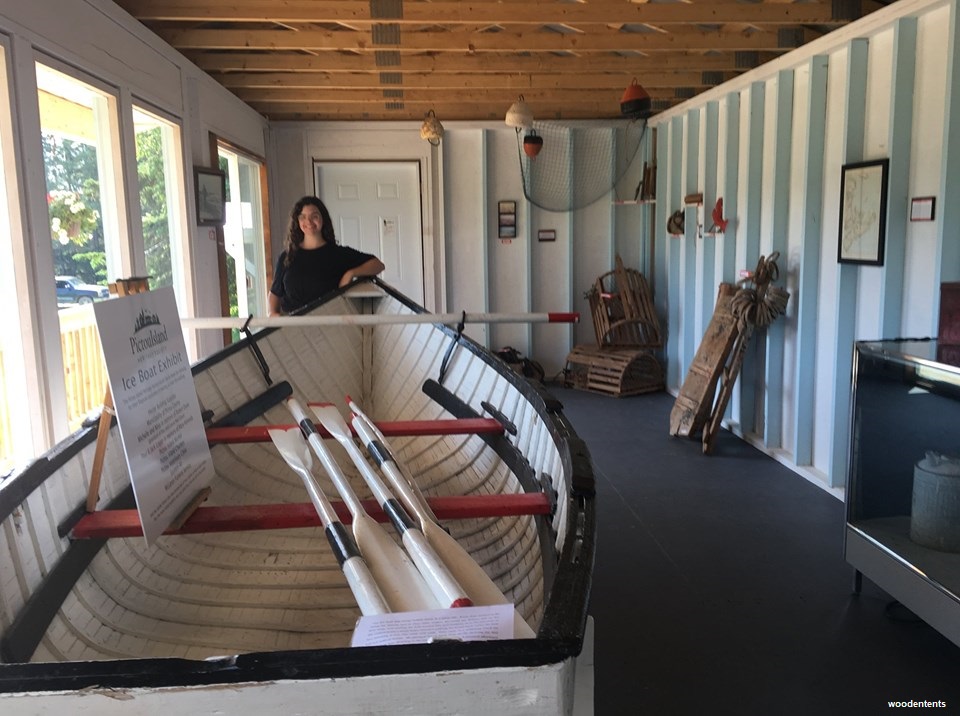
The iceboat preserved at Pictou Island’s Heritage Centre represents a way of travelling that required people to move between water and ice during the same journey. Its significance extends beyond the history of one surviving boat. It recalls the crews who carried mail, the Islanders who needed supplies or medical help, and the judgement involved in deciding whether a winter crossing could be made.
Northumberland Strait iceboats combined a wooden boat with runners. The Northumberland Fisheries Museum describes them as resembling oversized dories; Parks Canada explains that runners allowed them to travel over ice as well as through water. A crew could move the boat over a frozen surface and use it afloat where the ice opened. The boat answered the problem of a crossing that was neither entirely water nor a continuous road of ice. [1, 2]
A changing surface beneath the crew
The museum’s Pictou Island exhibition emphasizes that heavy slush could be particularly dangerous. A boat might become trapped in it, and efforts to escape could break oars. Slush could also appear solid enough to stand on when it was not. Tides and currents moved ice floes, with the risk of a boat being overturned or crushed. [1]
These conditions help explain why the history is as much about people as equipment. Winter service required local knowledge of tides, open leads and moving ice. Possessing a boat did not ensure that a crew could cross, or that a route used on the outward journey would remain available on the return.
Part of a wider Strait tradition
Pictou Island’s boats belonged to a regional history of winter communication. Parks Canada dates the start of the Cape Traverse–Cape Tormentine winter mail service to 19 December 1827. It carried mail and passengers across the Strait, using small boats adapted for ice, until a car-ferry icebreaker entered service in 1917. That history is commemorated as a National Historic Event. [2]
The Capes service was a different route from Pictou Island’s connection with the mainland. Its dates do not establish when Island iceboat travel began or ended. The comparison shows how communities around the Strait developed similar ways of negotiating winter isolation, while each route retained its own crews and history.
Mail, supplies and the need to get home
Federal records document organized mail carriage between Pictou and Pictou Island by 1902. Community history remembers iceboats carrying winter mail and, in emergencies, ill or injured Islanders. Such crossings connected households with mainland services when ordinary boat passage became difficult. [3, 4]
Not every winter journey was made in an iceboat. The museum exhibition reproduces Ruth Munro’s account of Ward MacCallum crossing with his horse Collie in March 1921. On the return, he encountered an opening in the ice and used part of his sled to bridge it. The story is Munro’s preserved account, rather than an independently verified reconstruction of the crossing. The same museum record quotes diary entries about people walking to Pictou over the ice in 1921. Together, these accounts show the variety—and danger—of winter travel. [5]
When steamships could go no farther
The Minto and Stanley emergency of 1903 illustrates why large vessels did not eliminate the need for small craft and travel over ice. The Daily Patriot reported on 23 February that nineteen Minto passengers had reached Pictou Island while thirty-five remained aboard. Some intended to continue toward High Bank in lobster-factory dories; the report records the plan without proving that this onward crossing occurred. [6]
The iceboat now preserved at the Heritage Centre was built decades later. It should not be identified as a boat used in the 1903 emergency. The connection is a broader one: winter transport continued to rely on several methods, even after powerful steamers entered Strait service.
The surviving Pictou Island boat
PIHS accounts attribute the preserved boat to Vincent Turple Sr. They disagree on its construction year: 1940 appears in one account and 1941 in another. Eddie “Spike” MacDonald is remembered as its operator and the Island’s last iceboat postmaster. The conflicting dates leave the boat’s place in the twentieth-century winter mail history clear, while its exact construction year remains unresolved. [3, 4]
Aircraft introduced another means of carrying mail. A postal Air Stage flight to Pictou Island is documented on 1 April 1949. Local accounts associate the end of iceboat service with about 1950–51, but the precise handover remains uncertain. Winter travel changed through overlapping services rather than one securely dated replacement. [4]
Preserving the crossing
The community historic-sites account records the surviving iceboat being housed at the Northumberland Fisheries Museum from August 2008. PIHS photographs document its relocation on the Island in 2019. Today, the boat at the Heritage Centre allows visitors to examine an object connected with the work of maintaining Island life through winter. [3, 4]
Its preservation gives the wider history a focus: a boat built for both water and ice, operated by people who understood that neither surface could be taken for granted. Beside the object belong the stories of its builder and operator, winter mail, emergency travel and the other methods Islanders used to remain connected.
Sources and further reading
- Northumberland Fisheries Museum & Heritage Association, Ice: A historic link for Pictou Islanders. Museum exhibition introduction: wooden boats, winter connections and ice hazards.
- Parks Canada, Ice Boat Service National Historic Event. Regional Capes route, 1827–1917; boats fitted with runners.
- Pictou Island, Historic Sites. Community account of Vincent Turple Sr., Eddie “Spike” MacDonald and the surviving boat.
- PIHS transportation research; Ruth Munro, Pictou Island (1984); federal postal evidence summarized in the PIHS transportation research register. Boat construction and service-transition dates remain qualified.
- Northumberland Fisheries Museum, transportation record, reproducing Munro’s Ward MacCallum account and entries from Jessie MacCallum MacDonald’s diary.
- Daily Patriot, 23 February 1903, p.1, UPEI Robertson Library, University Archives and Special Collections. See Frozen in the Strait for the full emergency account.