For many Pictou Island families, the schoolhouse was one of the places where a small community became a shared world. Children of fishing and farming households learned together. The story follows successive Island schools, generations of teachers and pupils, and the building now used as a community centre.
The early schoolhouses
In 1845, Islanders petitioned for help with a school, a breakwater and a road. The Assembly Journal records the petition, though it does not say that funding was granted or a school built.
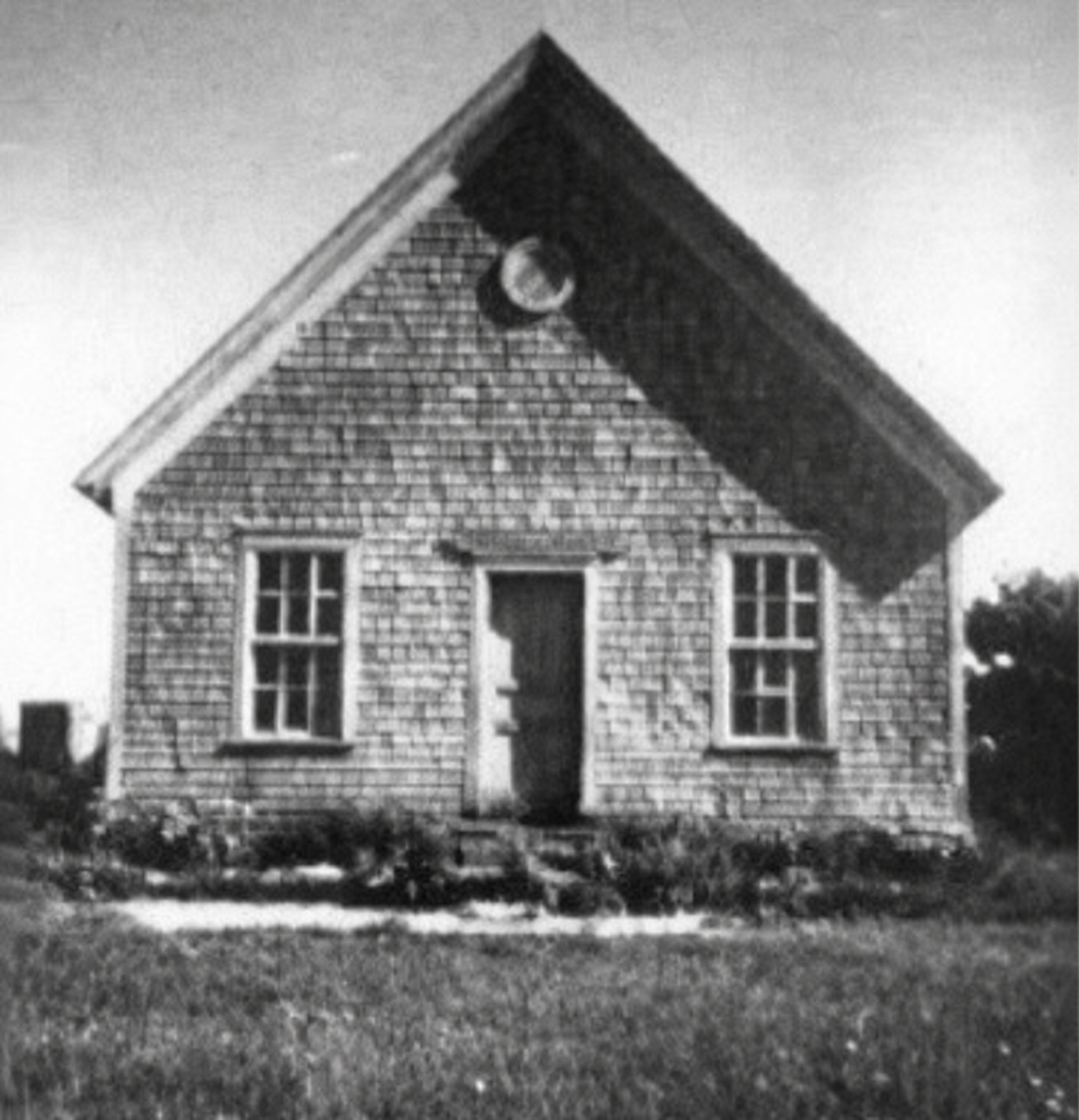
Ruth Munro and Kenneth MacCallum wrote that an earlier schoolhouse burned in 1874 and that another was built on Charles MacCallum’s land. It is not clear when the replacement was built. Education reports record no school operating in the year ending October 1882; another report describes a comfortable schoolhouse built in summer 1884 and school operating the following winter. It is not clear how these accounts fit together. Neither building was the present community centre.
Munro recalled a 1937 register with 60 pupils, enough to require additional teaching help. She named Lorina MacKay as a substitute or additional teacher.
Pictou Island’s earlier one-room schoolhouse, replaced by the present community-centre building. Photograph date unknown. Photographer and date unrecorded
Inside the one-room school
Hilton McCully remembered teaching on Pictou Island in 1944–45 and 1945–46. His one-room school stood near the middle of the Island, on the upper side of the road facing the water, across from Campbell MacCallum’s farm. He recalled 18 or 19 pupils, from Primary to Grade 10, and the challenge of keeping the uninsulated building warm in winter.
In his separate book Pictou Island: Bha E Cho Snog, McCully reproduces a return headed “From 1945–46 Register” naming him as teacher, and extracts from a school day-book covering winter and spring 1946. These support his account of teaching during that year. Munro’s compiled chronology names Vernon Smith for 1945–46; the original signed return and appointment records have not been recovered, so a separate or partial-term appointment remains possible. McCully also explains that he reconstructed the grades in his 1944–45 pupil list using 1945–46 information. His reconstructed grades and notes on attendance are not original annual enrolment totals.
Other records name Margaret Ross as an Island teacher in 1931, and remember Doris Thelma MacKeil MacMillan and Annie Fitzgerald as former teachers. Some dates in the teacher lists are uncertain.
Provincial directories name Heather MacPhail as teacher in 1966–67, Linda Hemphill in 1967–68, Viswanath Jeevan Salins in 1968–69 and William MacMillan in 1970–71. The 1968–69 directory lists one teacher and six pupils. Schooling continued in different forms after regular classes ended.
The teacher table below follows Munro’s compiled list. She printed the name Viyi Sailens; the provincial directory gives Viswanath Jeevan Salins. Some entries and dates remain uncertain.
The present building
Island histories say the present school and community-centre building replaced the older school in 1958, and credit its design to William West of Hopewell. MacCallum named a construction crew; McCully credited Higgins’ Construction and foreman Stan Porter. The original building contract and design plan have not been found.
School directories offer glimpses of a changing student population: approximately 37 pupils in 1957–58 and 28 in 1959–60, each with one teacher. McCully’s separate 1958 list contains 39 entries. These counts were made at different times, so they cannot be directly compared as annual totals.
Regular classes and later education
Munro identified 1970–71 as the final year of regular public-school classes, with William MacMillan as the last regular teacher. Some later accounts use 1972 for the wider closure transition. Island children continued to learn through mainland schools, home schooling, correspondence and later part-time arrangements, including the SchoolNet-connected school of 1999.
In the early 2000s, Island children learned at home and in the community centre, with visiting teachers, time at Church Street Elementary School in Westville and correspondence courses for older students. A school webpage also remembered nature walks, projects and concerts that brought school and community life together.
MacCallum reports home instruction beginning in 1985. Industry Canada’s 2003 account dates Pictou Island’s SchoolNet connection to 30 March 1999 and describes one room, one teacher and three pupils. It identifies the Island school as the final connection in the national schools-and-libraries initiative. In the House of Commons on 3 November 1999, Industry Minister John Manley also recalled the connection of the three-pupil school that March.
Children, teachers and a digital connection
A photograph dated 29 May 1911 names James Jeremiah Turple as teacher and lists sixteen pupils. The caption does not say which child is which.
McCully reproduced a separate list headed “Pictou Island School as of August 1, 1911,” with 42 names. A later account dated the list to 1913; the reproduced heading gives 1911. The original register has not been inspected.
An original two-page K-Net account survives from the 30–31 March 1999 SchoolNet connection. It recounts the journey from Caribou with computer and satellite equipment, the installation outside the school/community centre, and the arrival of Internet access for three pupils. The report names the Island teacher as Tracy Langille. It also recalls that ice returned overnight, prompting a chartered flight off the Island; according to the contemporary captions, the plane landed on an Island road to collect the visitors. Industry Canada and parliamentary sources separately confirm the national milestone on 30 March 1999.
A community centre
The Pictou Island Community Association says it was incorporated in 1987 and began renovating the old schoolhouse for use as a community centre. The building later welcomed students again, including during the 1999 SchoolNet connection.
Ruth Munro’s list was compiled from records by Roy MacCallum, with additions from Doreen Bower, Miriam Patterson and others. Munro cautions that some dates may be inaccurate. The 1936–38 conflict remains visible: her prose names Charles Daniel and Lorina MacKay, while her chronology names Charles Dan Taper and Doris MacKeil.
The teacher list’s Alfred MacLean entry does not independently identify the teacher as nurse Alfred H. MacLean. McCully’s pupil and parent recollections remain attributed memoir evidence; they do not establish new biological relationships or authorize disclosure of potentially living former pupils.
K-Net's contemporary report identifies Kim MacKinnon and John Moreau, including the 'Kim and John' return flight, while Zachary Tumin's later Harvard account identifies Kim McKinnon and Ian Cameron. The differences have not been reconciled with staffing, travel or production files. The K-Net report survives in two archived pages. The report's announced video is a possible original audiovisual record, without evidence that it survives. Teacher-licence registers concern certification, not proof of an Island appointment. The original 1937 and 1944–1946 attendance registers have not been retrieved. Contemporary inspector reports discuss the district but do not identify the disputed 1945–46 Island teacher.
Building and register notes: the original fire record remains unrecovered. The inspected 1882 education report, p.44, and 1884 report, p.50, document absence of a school in the earlier reporting year and summer 1884 construction followed by winter operation. The 1958 date and William West design attribution are later local-history accounts, not newly confirmed from the 1957–59 education records or 1988 heritage inventory. Munro’s 1936–38 prose and teacher chronology disagree; disputed entries remain in the register. The MemoryNS catalogue describes the Trustees of School Section No. 57 fonds, MG 11–10, held by the Pictou County Genealogy and Heritage Society, as a 1901 school register recording pupils’ names, ages, parents or guardians and attendance. The manuscript has not been inspected here. Its catalogue date does not identify it as a 1937 or 1944–46 register. The date the school section was dissolved also remains uncertain. The 1999 K-Net account survives in two archived pages. Its contemporary report and later accounts should be read as distinct sources.
The SchoolNet date and school size are now supported by inspected federal sources, beyond the surviving web-feature index. Industry Canada’s 2003 publication, printed p.21 (PDF p.20), records 30 March 1999 and one teacher/three pupils; Manley’s 3 November 1999 Hansard statement independently documents the federal announcement. These federal sources do not identify the pupils; the separate K-Net original now survives in two inspected archived pages. PICA’s institutional history supplies the 1987 renovation account; it does not settle the original building’s construction date.
Nova Scotia Archives delayed-registration evidence shows that a Pictou Island teacher consulted school registers and found a 1924–25 entry. This supports consultation of a register, not a complete census of Island children and not the full building chronology. The catalogue identifies one 1901 school register in MG 11–10. The manuscript, later register survival and the school section’s dissolution date remain separate open questions.
The reported 60 pupils in 1937 may not have been the school’s highest enrolment. Home instruction beginning in 1985 does not by itself prove a regular public-school reopening. Heartz’s 16 April 1907 account confirms a school operating on the Island, without identifying its building generation or footprint.
The 1968–69 and 1970–71 provincial directories describe their approximate enrolments as snapshots taken on 30 September 1968 and 30 September 1970. They may vary during the school year and are not official annual statistical totals. They should be read separately from classroom attendance, school census returns and copied historical class lists.
Related date in Island history
From the Museum’s shared Timeline; approximate dates and ranges retain their qualifications.