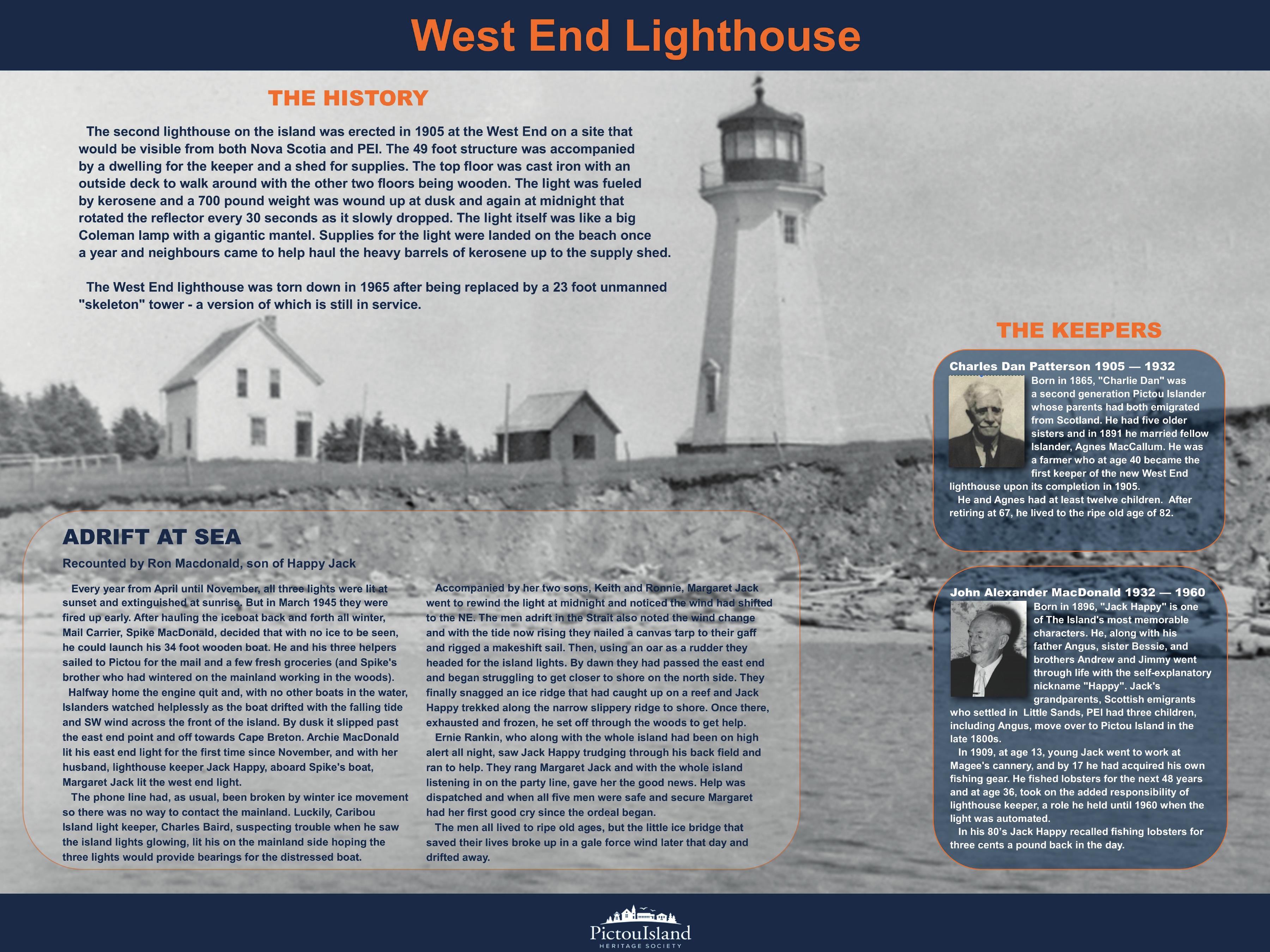
At the west end of Pictou Island, the lighthouse was both a guide to mariners and a place where people lived. A historic photograph in the PIHS collection is captioned “West End Lighthouse — Home of ‘Happy Jack’.” The station’s history brings together its keepers, their households and the March 1945 emergency remembered by Ron Macdonald.
The staffed West End light, its keepers and the March 1945 emergency remembered by Ron Macdonald.
THE HISTORY
The West End Lighthouse entered service in 1905 at the island’s western extremity. The original tower was a tall octagonal wooden structure with a red iron lantern, distinct from the separate wharf-side light on the south shore. Charles D. Patterson was appointed keeper on March 29, 1905; John Alexander “Jack Happy” MacDonald later became the principal staffed-era keeper. Melvin MacDonald is remembered as a caretaker after automation.
The light is reported to have been automated on February 15, 1962. The wooden tower was later replaced by a skeletal light; the exact dates of removal and related changes remain uncertain.
Completed PIHS West Lighthouse panel, including its historical illustrations. Pictou Island Heritage Society interpretive panel
ADRIFT AT SEA — Attributed oral history
Ron MacDonald later recalled an emergency associated with the West End Lighthouse in March 1945. Records from the time confirm difficult ice conditions around Pictou Island in late March, but the particular lighthouse incident has not been confirmed in a contemporary record. The story is shared here as Ron’s recollection.
Building a recognizable light
The federal Marine report for the fiscal year ending 30 June 1904 describes the new West End Lighthouse ahead of its planned opening at the start of navigation in 1905. Benjamin D. Huntley of Vernon River, Prince Edward Island, built it under a $1,470 contract. The white octagonal wooden tower rose 49 feet to the lantern ventilator; its red iron lantern stood over a light elevated 61 feet above high water. Reflectors formed its catoptric apparatus. The report specified a repeating group of three white flashes, with fifteen-second intervals followed by a thirty-second interval. This was the pattern proposed before opening; it does not establish how the light operated on its first day.
appointed 29 March 1905; retirement annuity effective 30 January 1934
The 1905 Marine appointment table records C. D. Patterson appointed on 29 March 1905 at $400. A later federal retirement return names Charles D. Patterson, Pictou Island keeper, with a $499.98 annuity effective 30 January 1934. The 1933–34 salary accounts list Patterson to 29 January and J. A. McDonald from 23 August, overlapping for several months. These are accounting periods, so the exact date their duties changed hands remains uncertain.
Opening and later keeper accounts
The Marine report for 1905 says the West End light was put into operation at the opening of navigation, flashing every twenty seconds. This operating description differs from the three-flash sequence proposed in the earlier construction report. The report names Benj. D. Huntley as contractor at $1,470; the contract amount does not include a confirmed total for all station costs.
The 1934–35 salary account lists J. A. MacDonald at Pictou Island (W.E.) for $420. The initials and station fit the existing Jack Happy keeper history, but the row does not itself supply his full name, appointment instrument or first duty date. The 1934 published list shows eligibility, not an appointment.
John Alexander ‘Jack Happy’ MacDonald
accounted from 23 August 1933; automation 15 February 1962 reported
John Alexander ‘Jack Happy’ MacDonald is strongly identified as the later longtime West End keeper. Records use both MacDonald and McDonald, and both Jack Happy and Happy Jack; a proposed military-record identification remains unconfirmed.
Sources
Pictou Island Heritage Society, West End Lighthouse interpretive panel; text credited to Lorne Matheson; federal lighthouse and personnel records.
Sources and evidence notes
The July 2026 Coast Guard amendments identify the west-point skeletal aid as No. 897. It is distinct from West Breakwater No. 898 and South No. 899. Secondary specialist histories report 15 February 1962 automation and 1965 tower replacement; these describe separate events. The original orders and caretaker appointment remain unrecovered, so the precise endpoints are not newly confirmed.
The West End station, appointment and retirement records identify C. D. or Chas. D. Patterson as Charles D. Patterson. The West End J. A. McDonald/MacDonald salary entries belong to John Alexander “Jack Happy” MacDonald, read alongside his named Gazette entry and Island career. These records and the Island histories help identify the abbreviated names. The overlapping pay periods do not establish the day the keepers changed over.