When Fire Struck
Fire, folklore and the volunteers who protected Pictou Island.
On Pictou Island, a fire could threaten far more than one building. Before engines, pumps and organized volunteers, families faced burning barns, homes and working equipment with the help of neighbours and whatever water and tools were at hand. The surviving record is fragmentary, but it tells a striking story: an old legend of a forest set ablaze, a lighthouse keeper fighting for his lantern, a succession of twentieth-century losses, and, eventually, a volunteer fire department created by Islanders themselves.
The story of Granny Boyd
One of the oldest traditions concerns the tensions between early Irish tenant families and later Scottish settlers. In his 1877 History of the County of Pictou, George Patterson described bitter disputes among those communities. He also recorded a fire that consumed much of Pictou Island’s forest near the departure of Irish families, with responsibility attributed to the wife of one of the departing settlers. Patterson did not give her name. [1]
A later version identifies her as “Granny Boyd.” The name appears in a letter written by J. D. MacCallum, Q.C., to The Pictou Advocate in response to its article “Requiem for an Island?” of 13 December 1978. Ruth Munro reproduced MacCallum’s letter in her 1984 local history. He described the wife of one of the departing Irish settlers as the person whom tradition blamed for starting the forest fire. The original newspaper issue and publication date of the reply remain to be recovered, but its wording survives in Munro’s reproduction. [2]
The legend must not be confused with proof of arson. It has been transmitted through historical accounts and community memory, and the later sources may depend on earlier tellings. Yet the story deserves a place in island history: it preserves memories of conflict, departure and a landscape people believed had been violently transformed.
Was the same story told elsewhere?
There is a useful parallel—but not an identical incident—on Peche Island in Ontario. Windsor Public Library preserves a tradition about Rosalie Laforet, a widow compelled to leave the island in the 1880s who was said to have cursed it. A mansion there later burned. As with Granny Boyd, the story connects a woman’s displacement with misfortune on an island. No source establishes that the two legends arose from the same event or travelled between communities. The resemblance is a folklore motif, not independent corroboration of the Pictou Island fire. [3]
Fires before the organized department
Ruth Munro reported that an earlier island schoolhouse burned in 1874 and was replaced. The reported date remains a local-history claim; later records raise questions about the chronology of school construction. The school fire is therefore best presented with attribution rather than as a fully resolved incident. [2, 4]
The best-known nineteenth-century incident was at the East End Lighthouse. In April 1876, keeper Andrew Hogg described explosions in the lantern, ruined lamps, broken glazing and damage to the structure. The flames were overcome, and secondary report-derived accounts say the light was restored within days. The detailed account is transmitted through later report-derived histories; the exact original federal page remains a separate source check. [5]
More personal evidence survives through selected entries from the diary of Jessie MacCallum, wife of Hector MacDonald, transcribed in Munro’s book. Her notes record “Campbell’s barn” burning on 5 June 1926, “Happy Angus” extinguishing an engine fire on 18 March 1927, Dan Hector’s house burning on 28 October 1928, and two of Lauchie Rankin’s barns burning on 10 May 1929, with feed and a yearling lost. A fire on 26 June 1935 damaged Hector MacCallum’s kitchen and veranda. The entries are primary-origin material preserved in a later transcription: neither the original diary nor independent fire reports have been inspected for each event. [2, 6]
Elsewhere in Munro’s account, Archie MacDonald’s loss of his house by fire affected plans to operate the island ferry. The date remains uncertain. Such accounts demonstrate that fires could undermine the interconnected livelihoods of farm, fishing and transport families. [2]
Seven Islanders decide to act
The Pictou Island Community Association’s institutional history records that seven residents met on 11 March 1981 to explore forming a volunteer fire department. The Pictou Island Volunteer Fire Department was incorporated that June. Its purpose was to provide fire prevention and firefighting services to island residents and landowners. In 1989 a steel equipment building was erected. [7]
The names of the seven founding residents have not yet been verified from the organizing minutes or incorporation file. Later officers should not be substituted as founders.
A fire hall takes shape
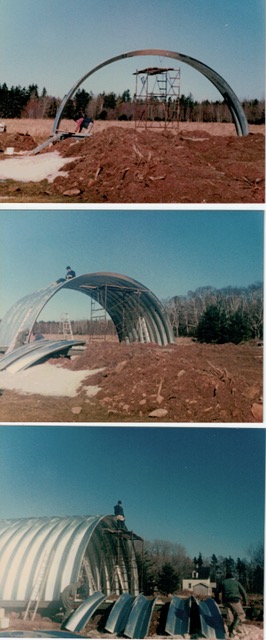
The department’s steel equipment building was erected in 1989. Construction photographs from the Elwood Rankin Collection, supplied by Lorne Matheson, show the arched structure taking shape. PIHS has confirmed the subject, year and permission to use the photographs; the individual photographer and workers have not been identified. [7,10]
Protection adapted to an island
The department’s history describes a practical solution to isolation: distribute firefighting capacity rather than rely entirely on a central truck. Backpacks, household extinguishers, smoke and carbon-monoxide alarms, property sketches marking fuel and water supplies, a well pump powered by solar panels and a four-wheel-drive vehicle with a 250-gallon tank all formed part of its approach. A First Responders program began in the mid-1990s, extending the volunteer role to medical emergencies and evacuation preparations. [7]
The arrangement required continuing community participation. An October 2022 PICA minute asked seasonal residents to return water-based extinguishers to the Fire Hall before departing for winter. Such details reveal a local system of equipment management, training and shared responsibility—not simply a building containing firefighting gear. [12]
A changing service, 2025–2026
By the summer of 2025 the department had purchased land for a proposed replacement hall. The PICA annual report anticipated a replacement-hall project costing more than $200,000. The department was fundraising, training, and acquiring equipment for medical transport, including a decommissioned ambulance and CPR manikins. A new hall had not been documented as completed. [9]
In August 2026 PICA minutes referred to two fire responses during that season, without naming either incident. They also recorded the acquisition of 15 wildland firefighting suits and a shift in emphasis toward forest and grass-fire prevention and response. In September, meeting minutes reported a $29,000 grant for firefighting suits and described plans for wildland and First Responder training. The grant amount comes from the local minutes; it should not be conflated with awards reported for other fiscal years. [13, 14]
The same period brought discussion of the municipality’s fire-risk assessment and a proposed fire-services levy. PICA minutes describe meetings, questions about voting procedures and further consultation. Those records do not establish that a levy was adopted, rejected or that the new hall was built. [14, 15]
What the island chose to protect
The Fire Department story connects the early forest legend with a modern community institution, but it also shows a profound difference between them. In the old story, people remembered fire as a symbol of division. In the modern record, Islanders organized to prevent fire and help one another face it. Preserving the history means naming the volunteers, documenting the lost homes and livelihoods, and remembering that the service was created and sustained by people who understood what isolation demanded.
Sources and related history
- Ruth Munro, Pictou Island (1984) — local history and selected diary transcriptions
- PICA — institutional history
- Fire Department — institutional history
- Pioneer Cemetery and funeral history
- Transport and wharf history
- George Patterson, A History of the County of Pictou (1877), p. 282 [1]
- Windsor Public Library — Peche Island folklore comparison [3]
- PICA minutes, October 2022 — seasonal extinguisher returns [12]
- Keeping the Island Lit — lighthouse history [5]
[2,6] Ruth Munro (1984), especially pp. 14–15, 27, 32–34, 47–48 and 54–55: Granny Boyd letter reproduction, ferry account and diary selections. The original newspaper reply and diary remain uninspected. [4] MacCallum school/institutions evidence retains the rebuilding conflict. [7] PICA institutional Fire Department history. [9] PICA AGM, 23 August 2025, Fire Department report. [10] Elwood Rankin Collection via Lorne Matheson, 18 October 2026, with PIHS 1989 identification and use permission. [11] Distinct wharf-project records belong in Living by the Strait. [13–15] PICA meeting minutes, 15 August, 26 September and 27 June 2026: reported activity, grants and levy deliberations, rather than proof of a completed hall or adopted levy.
Historical photographs