On an island separated from the mainland, worship and remembrance were not simply matters for a minister or an undertaker. Families gathered in homes, later used the schoolhouse and built a church together. Neighbours also had to care for the dead and keep burial places accessible when storms, ice and distance made outside help uncertain.
The church, the original eroding burial ground, the present Pioneer Cemetery, the later Church Cemetery and the surviving hearse are not separate curiosities. They are parts of one continuing story: how Islanders supported one another, how stone and memory carried family names, and how volunteers preserved places that might otherwise have been lost.
Read The Island Hearse: Funeral Journeys and Community Memory
Chapter 1
Faith before a church
Long before a dedicated church building, Island families could worship together in homes and the schoolhouse, with occasional visits from ministers. Later local history records the importance of Scottish Presbyterian traditions and Gaelic in many households.
Scottish Highland settlers arrived on Pictou Island in 1819, including John MacDonald, Donald MacDonald and Charles Campbell; Kenneth McKenzie followed in 1820. MacCallum and named MacLean family lines have documented Tiree connections. The precise Scottish origin of the Pictou Island Patterson line remains unresolved. These Highlanders brought the Church of Scotland with them. The “Kirk” was a Calvinistic Protestant faith with Presbyterian roots in the southwest of Scotland. Its ethos of industry and community was the perfect salve to the hard scrabble existence the first settlers faced.
PIHS-approved interpretive history describes nearly a century of worship before the Island had a church building, with Gaelic central to religious life. Sunday morning services were held in various family homes, with Sunday afternoons reserved for Sunday school. Additional prayer meetings on Sunday and Wednesday evenings meant there was no shortage of opportunity to worship.
Ruth Munro, citing the Truro News, reports visits by Rev. Robert Grant in the summer of 1845. The original newspaper account has not yet been inspected, and the minister’s exact identity and pastoral charge remain unresolved. Local histories place an Island school in the mid-nineteenth century. Official education records directly confirm that a Pictou Island school was operating by 1872, while the exact date of the first school and the succession of early school buildings remain uncertain. Local history says church services and events were held in the school in the summer months.
Over time the influence of the Church of Scotland waned, and parishioners began to identify as members of the Presbyterian Church in Canada. By the 1880’s, with the population hovering at 200, most were Presbyterian save Lewis Lawrence, a Portuguese fisherman and Roman Catholic who had married Ann Patterson. The 1884 Inveralt salvage disaster had direct Island connections: Lawrence, an Island resident, and native Islander Hugh MacFarlane were among the losses, while Island crews also took part in the rescue.
PIHS-approved interpretive history remembers the Presbytery sending student ministers to stay on the Island from June until September. They boarded with various members of the congregation, or stayed in a house that might be vacant. Three of them even found Island brides! Once a year, an ordained minister arrived to hold the Sunday service and offer Holy Communion. On these occasions, children born over the past year, were baptized. The ordained minister would also come across to perform funeral rites if a member died in the summer. In the winter, funerals were conducted by Islanders themselves. Weddings were generally held on the mainland, with everyone returning to the island for a joyous party and celebration.
Chapter 2
A house of worship
The church’s opening in October 1910 is a story of collective effort and three distinct public events. The building was dedicated on Friday, 14 October; a preparatory communion service followed on Saturday; and the first Sunday services on 16 October included Gaelic and English worship, communion and baptism.
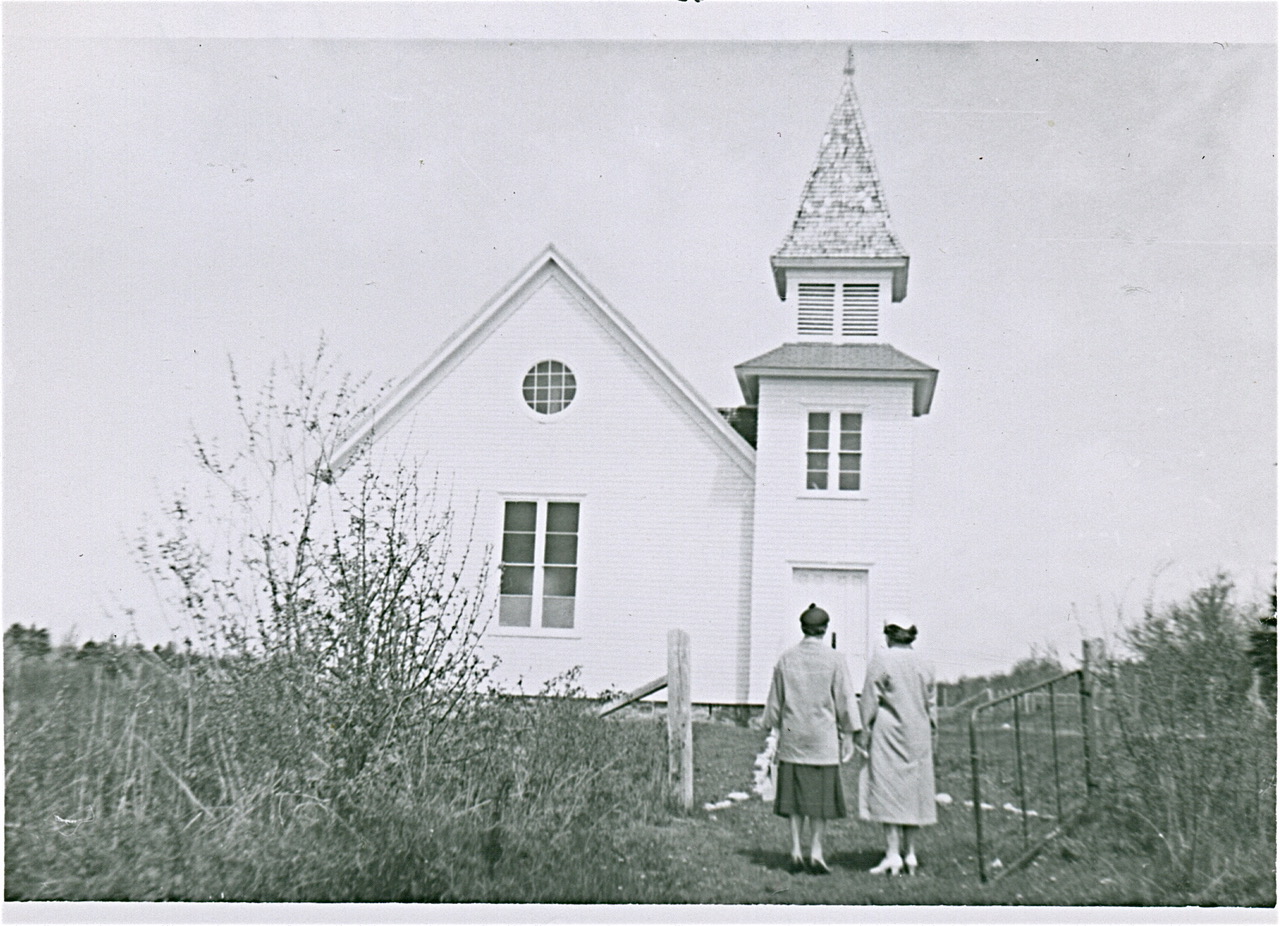
By the turn of the century the congregation was ready for a church of their own. In 1908, PIHS-approved interpretive history describes young student minister Archibald Sutherland of Trenton as advocating for the project, while “Deacon” Charles MacCallum is credited with donating a plot of land. It was finally agreed that each member would contribute $50, more than a month’s wages, in cash or labour in kind, and the Islanders set about building their very own church. Two years later, after coordination and encouragement from the congregation and its supporters, construction was completed. The Pictou Advocate announced the formal opening for Friday, 14 October 1910, and its later report describes the church being dedicated for public worship that evening. A preparatory communion service followed on Saturday, 15 October. The first Sunday services, on 16 October, included Gaelic and English worship, communion, an afternoon baptism and an evening closing service. The newspaper’s retrospective reports about thirty communicants and five infants baptized. Hector MacDonald and Charles MacCallum served as the first elders of the church.
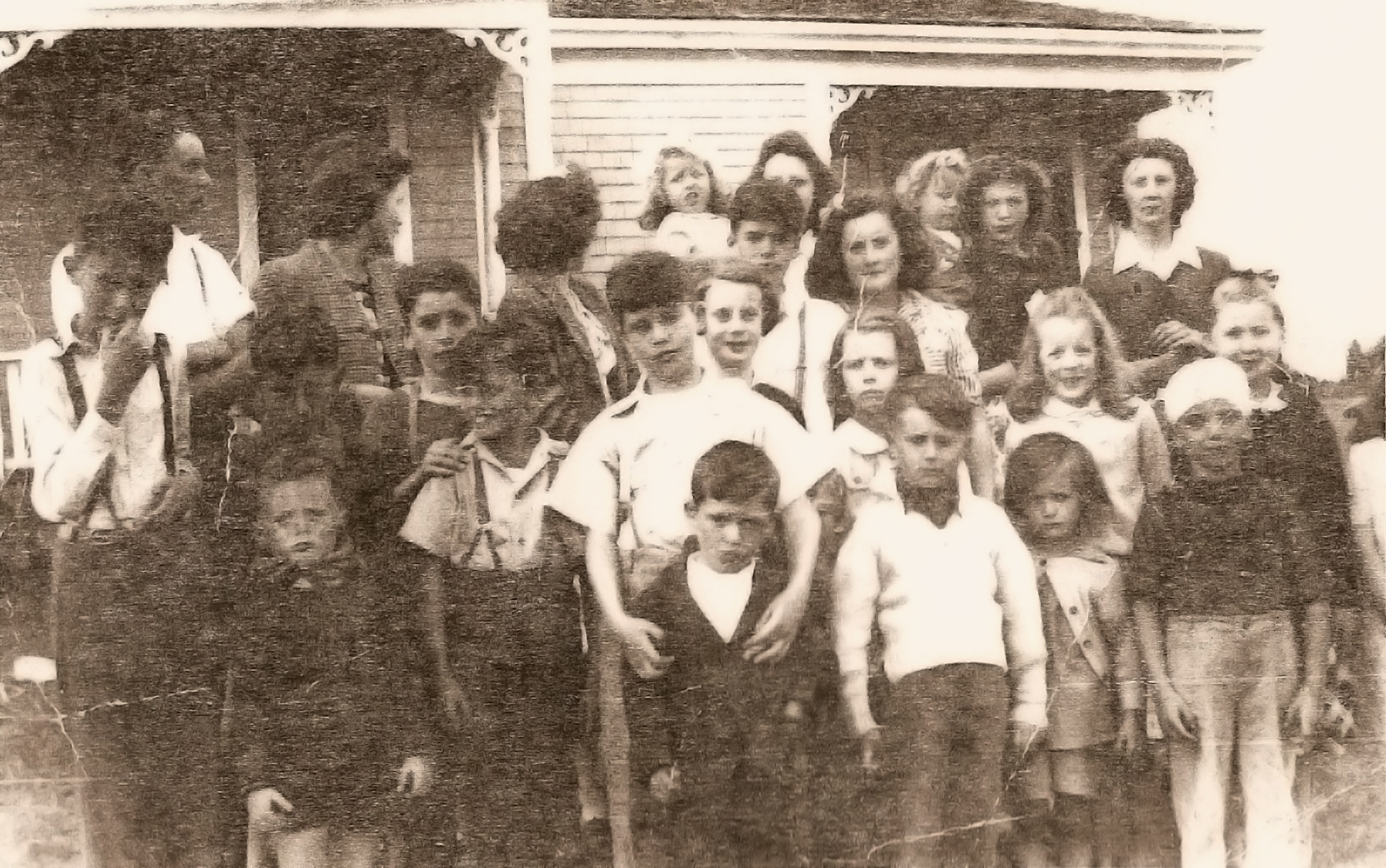
The PIHS interpretive account describes the congregation continuing as Presbyterian until 1925, when the national movement to unite the various Protestant denominations, under the Church Union Act, arrived on Pictou Island. A vote left the congregation fairly evenly divided, and it was decided that the Presbyterians would continue to use the church, while the members of the new United Church of Canada moved back to the schoolhouse for their services. Within a few years it became clear to the Presbyterians that maintaining a church required the whole Island and a compromise was reached. Everyone agreed they would all worship together in the church, alternating student ministers, one year Presbyterian, the next year United. PIHS-approved interpretive history associates the Sutherland name with Archibald Sutherland’s support for the church project and places the naming at the 1961 anniversary celebrations. The exact donor and namesake history has not been resolved from the underlying church and land records. Over the years, like churches on the mainland, weekly services continued and groups formed, including Canadian Girls in Training, Crusaders, Lady’s Auxiliary, Sunday School, Bible School, and a Church Choir. Many older members of the community have fond memories of the beloved Sunday School Picnic - especially Jack Rankin‘s magic tricks, and the homemade ice cream. The practice of student ministers continued into the early 1970’s. At that point, the loss of government services on the Island led many longtime residents to leave for the mainland to be closer to schools and hospitals. The dwindling population made sending a student minister impractical.
 Enlarge & zoom
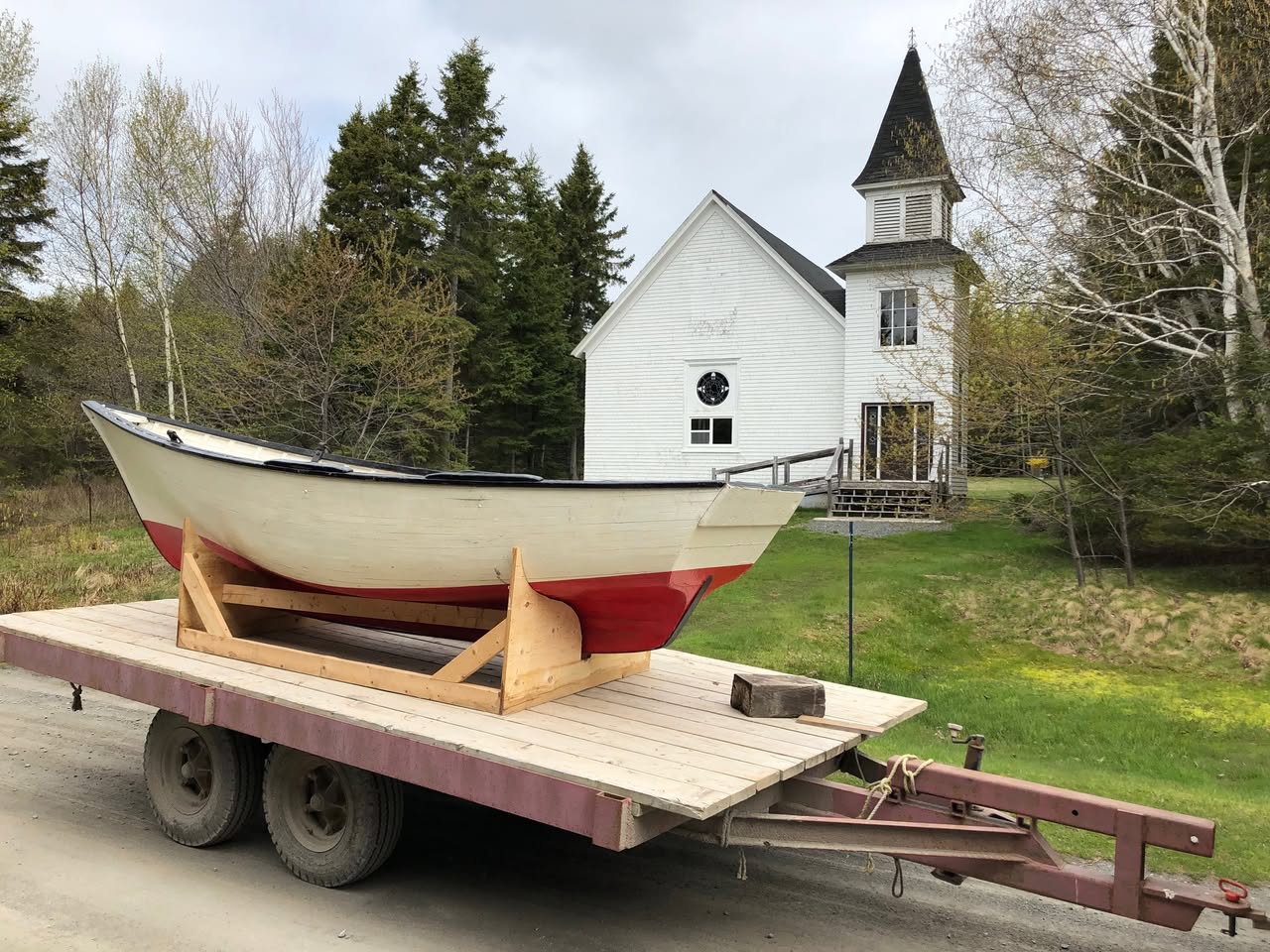
A boat passing Sutherland Memorial Church in May 2019
Chapter 3
The first burial ground
The oldest memorials at present-day Pioneer Cemetery may not mark the places where the people named on them were first buried. Island tradition describes an earlier south-shore cemetery threatened by erosion and the movement of headstones.
An earlier burial ground
PIHS-approved interpretive history places an earlier burial ground on a knoll overlooking Pictou Island’s south shore. It identifies two young boys who drowned off the Island’s west end as the first people buried there. That first-burial tradition has not yet been independently verified.
A surviving Pioneer Cemetery memorial records the death of Donald McCallum on 9 May 1830 at the age of three. His is the earliest death date identified in the current NovaStory/PARL memorial collection. The inscription establishes his name, age and death date; by itself it does not establish how he died, where his remains are located, or whether the present stone is the original marker.
From the shoreline burial ground to Pioneer Cemetery
The registered deed is dated 13 September 1890 and records Joseph A. McInnes transferring land to Alex J. Campbell, James Currie and John C. McDonald, trustees of the Pictou Island cemetery, for $40. It was registered on 3 November 1890. The deed describes part of Lot 11, including a public road twenty feet wide from the main road, and states that the road and cemetery together contain about one and one-half acres, more or less. That is a combined area, not a measurement of the cemetery alone. The deed does not establish the first burial date, which stones were moved, or whether remains were reinterred. County Council independently granted a cemetery public-road petition in January 1892; that later decision is distinct from the 1890 deed. Source: Pictou County Registry of Deeds, Book 98, pages 245–246, FamilySearch DGS 008627798, image 127.
PIHS-approved interpretive history records that headstones from the earlier shoreline burial ground were moved to the present cemetery as erosion threatened the old site. No stone-by-stone transfer list or complete reinterment record has yet been recovered. For that reason, PIHS distinguishes four separate questions: where a person was originally buried, where a memorial now stands, whether a physical stone was moved, and whether remains were reinterred.
Memorials older than the present site
The 2013 NovaStory/PARL survey documents 79 public-domain cemetery photographs associated with 75 source positions. Eighteen photograph records contain at least one death before 1890. Those early dates show that the cemetery preserves the memory of people who died before the documented 1890 land transaction of the present site.
A death date does not date the manufacture or placement of a gravestone. Some early memorials may be stones transferred from the shoreline burial ground; others may have been replaced or erected later. PIHS does not presently identify any individual pre-1890 stone as a confirmed transferred marker unless separate evidence supports that conclusion.
Erosion, memory and uncertainty
PIHS-approved interpretive history includes recollections of erosion exposing human remains at the earlier shoreline cemetery. These recollections help explain why the loss of the old burial ground remained important in Island memory, but they do not establish the fate of every burial.
The location and condition of the earlier cemetery, the number of burials affected by erosion, and the extent of any recovery or reinterment remain active research questions.
Restoration and stewardship
PIHS-approved interpretive history records a major restoration effort at Pioneer Cemetery in 1991, when volunteers cleared heavy growth and worked to recover and reset the cemetery landscape. Modern Pictou Island records document continuing community care of Pioneer Cemetery, including maintenance and headstone-cleaning work.
In August 2013, the Pictou-Antigonish Regional Library documented the cemetery through a plot plan and photographic survey. That record, together with historic transcriptions, family records, photographs and PIHS research, now forms the basis of the PIHS Cemetery Explorer.
Reading the cemetery record
The surviving stones are an important historical record, but they are not a complete list of everyone buried on Pictou Island. Unmarked burials, lost stones, replacement memorials and the eroded shoreline cemetery all complicate the record.
PIHS is continuing to compare historic cemetery transcriptions, photographs, church and civil records, family sources and land records. Where the evidence is uncertain, the Cemetery Explorer identifies that uncertainty rather than assigning a burial or stone movement that has not been demonstrated.
 Enlarge & zoom
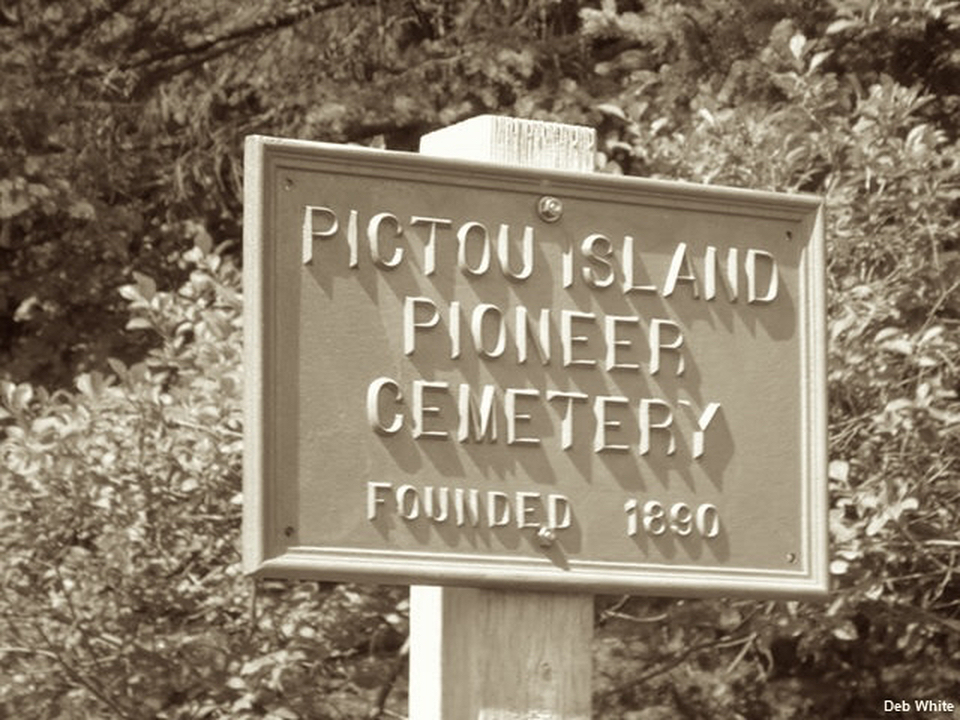
Pictou Island Pioneer Cemetery
Chapter 4
Death at home
In an isolated community, making a coffin, preparing for a funeral and travelling to a burial ground could require neighbours’ help. Ruth Munro and PIHS local accounts remember island-made caskets, a horse-drawn hearse and later adaptations as horses disappeared.
The Island hearse
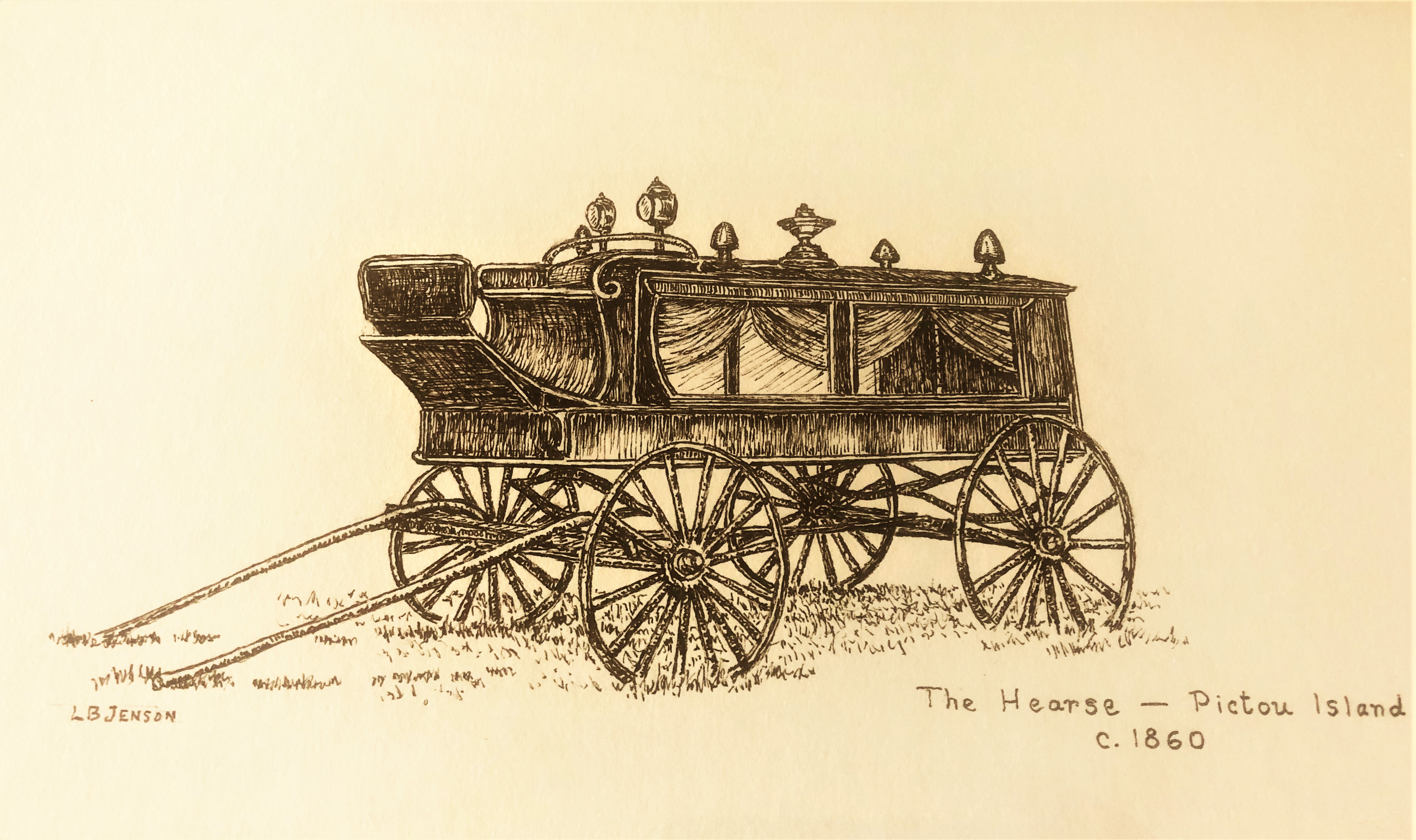
Pictou Island has preserved a historic horse-drawn hearse associated with Island funeral history. The surviving vehicle is now part of the Island’s heritage collection.
PIHS-approved interpretive history and Ruth Munro’s later local history say the hearse was obtained from McLaren Funeral Home in Pictou around 1910. PIHS has not yet located a contemporary purchase, business or shipping record confirming that transaction, so the acquisition should remain attributed rather than presented as documentary fact.
Later Island accounts also remember particular ways the hearse was used, including differences in horses or funeral fittings and attendants walking beside the vehicle. These are valuable parts of PIHS-approved interpretive history, but the evidence presently available does not establish them as universal or consistently followed Island practices.
As horse use declined, later Island history records adaptations in how the hearse was transported and preserved. The exact chronology and physical changes to the surviving object remain subjects for object-level and documentary research.
Bringing people home
PIHS-approved interpretive history remembers Island residents who died on the mainland being returned by ferry for burial on Pictou Island. Individual cases should be tied to specific records where available rather than treated as an invariant funeral custom.
William “Billy” MacMillan is remembered in PIHS-approved interpretive history as being returned to the Island after his death and as the last person carried in the old hearse. His Church Cemetery memorial and family history are independently documented; the “last hearse use” claim remains attributed interpretive history unless a contemporary funeral record is recovered.
Local care of the dead
Island evidence shows that some funeral and death-care work was carried out locally.
Hilton McCully’s firsthand memoir recalls spending a Sunday with five carpenters building a coffin and a rough box on Pictou Island during his 1944–46 stay. He does not identify the deceased. His separate account of lantern light and the sound of reserved coffin lumber being cut belongs to remembered death folklore.
Margaret MacCallum MacDonald was a professionally trained nurse and was appointed Public Health nurse for Pictou Island by 1925. Later professional memorial material credits her with preparing deceased people and assisting with or conducting funeral services. Those documented activities do not establish that she was a licensed embalmer or undertaker.
Ruth Munro records that the last coffin made on Pictou Island was built for Frank Munroe in 1974. The “last coffin” formulation remains attributed to Munro unless an underlying contemporary record is recovered.
A surviving historical photograph catalogued by An Iodhlann documents the funeral of Annie MacCallum MacFarlane and identifies Lachie Dan MacCallum and Jack and Bill MacDonald among those present. The repository describes Jack and Bill as assisting with the coffin; the description does not identify them as pallbearers.
Remembered practice and folklore
Regional Gaelic Nova Scotian traditions provide useful context for funeral and mourning history, but home wakes, prayers, keening, delayed winter burial and other regional practices require Island-specific evidence before they can be described as Pictou Island customs.
Folklore and community traditions associated with death, cemeteries and the hearse belong in clearly labelled folklore or oral-history contexts rather than in the factual account of funeral practice.
Preserving the object and the record
The hearse, Hearse House, photographs, memorials, family records and PIHS-approved interpretive history preserve different parts of Island funeral history. Together they allow visitors to see both what is documented and what survives through community memory.
 Enlarge & zoom
A drawing of the historic Island hearse
Chapter 5
A second cemetery
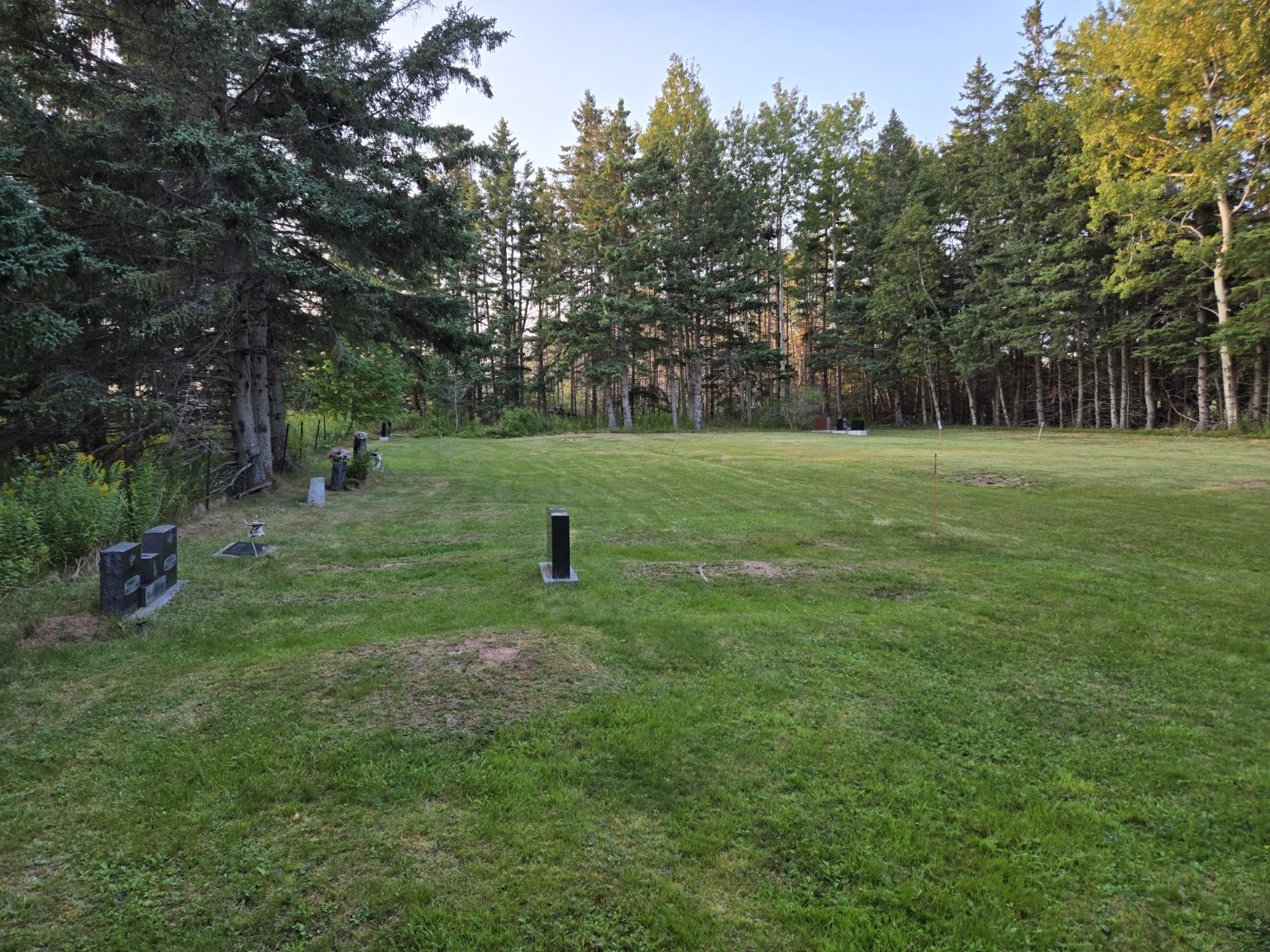
The cemetery behind Sutherland Memorial Church opened a new chapter in Island remembrance in 1959. The PIHS-vetted panel identifies James MacDonald and Lavinia Glover as its first burials in December of that year; the separate search for a complete burial register remains open.
A second Island burial ground
The Church Cemetery lies behind Sutherland Memorial Church. Memorial evidence confirms that the cemetery was in use by 1959.
Ruth Munro’s 1984 local history records that land for the cemetery was purchased from Gordon MacCallum in 1959 for $100 and describes twenty-four double lots, each twenty by twenty feet. PIHS has not yet inspected the underlying deed or plan, so those transaction details remain attributed local-history evidence rather than primary-verified facts.
Early memorials
A shared memorial records James D. MacDonald (1906–1959) and Lavina M. Glover (1917–1959). Their 1959 death years are the earliest currently identified among the memorial records documented by PIHS.
PIHS-approved interpretive history and Island community testimony identify James MacDonald and Lavina/Lavinia Glover as the first people buried in the Church Cemetery in December 1959. This account of the first interments is preserved as community history; the civil registrations do not name the cemetery or establish burial order.
The original Nova Scotia death registrations name James Duncan MacDonald and Lavinia Margaret MacDonald and record that both died on 10 December 1959. They record asphyxia associated with a bedroom fire and burial or removal to Pictou Island on 15 December 1959.
PIHS and Island community history remember an Aladdin lamp and carbon monoxide as the circumstances of their deaths. This local account remains part of their story, with attribution to the community that preserved it. The civil registrations document the bedroom fire and asphyxia; they do not independently identify an Aladdin lamp, confirm carbon monoxide by laboratory testing, or establish when the couple were discovered.
Family memorials and continuing use
The cemetery contains memorials to several generations of Island families. PIHS-approved interpretive history also preserves the story of the MacMillan family acquiring a large family plot after William “Billy” MacMillan settled on Pictou Island and married Annie Jane MacLean.
Family stories, shared markers and later memorials help document relationships across generations. A memorial, however, establishes commemoration and does not by itself prove the exact date of interment or every person physically buried in a family plot.
Documenting the cemetery
PIHS’s September 2026 survey records twenty-two memorial groups in twenty-nine original photographs, including additional views and context. These photographs document the visible memorial record at that time; they are not a complete interment register.
The Church Cemetery and Pioneer Cemetery continued to serve Island families in ways that may have overlapped. PIHS has not established a simple date when use of one cemetery ended and the other began.
Reading the record
PIHS continues to compare memorials, historic cemetery transcriptions, family records, obituaries, civil records and land records. Where the legal acquisition, first interment or burial location remains uncertain, the public record preserves that uncertainty.
 Enlarge & zoom
The Church Cemetery behind Sutherland Memorial Church
Chapter 6
Memory can be lost—and recovered
As the year-round community grew smaller, the older cemetery became overgrown and difficult to reach. Ron MacDonald and other volunteers led restoration efforts culminating in work remembered in 1991.
Outmigration accelerated during the late twentieth century as schooling, employment, fisheries, services and other pressures changed. Regular public-school classes ended in 1971, while some later PIHS accounts use 1972 for the broader closure transition. Many Islanders chose Seaview Cemetery on the mainland; cemetery changes formed part of a wider demographic history rather than resulting from school closure alone.
PIHS-approved interpretive history recalls the cemetery becoming overgrown with trees and bushes, particularly black locust. It preserves a story that Maggie Jane McCallum bought a plant from a travelling peddler as a rosebush and placed it on a family grave. That account belongs to community memory rather than a documented botanical history.
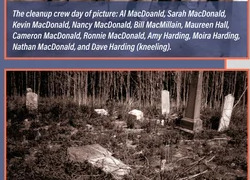
PIHS-approved interpretive history records that Ron MacDonald, a son of former lighthouse keeper Jack “Happy” MacDonald, returned to live on Pictou Island in 1989 and organized fundraising to restore the overgrown cemetery. The account credits donations from descendants and a $3,000 provincial grant with helping to bring machinery across to clear stumps and lift fallen headstones.
The restoration account describes Ron and fellow volunteers reclaiming the cemetery in the summer of 1991. Volunteers remembered repeatedly sharpening saws while clearing dense black locust, spruce and bushes. Their recollections preserve the work involved in recovering the landscape.
Modern Pictou Island records document continuing community care, including maintenance and headstone cleaning. PIHS-approved interpretive history reports some burials after the restoration, but named interment evidence and the date of any governing closure decision remain unresolved.
In August 2013, the Pictou-Antigonish Regional Library documented the cemetery through a plot plan and photographic survey. The surviving memorials, historic transcriptions, family records, photographs and PIHS research now form the basis of the Cemetery Explorer. They do not constitute a complete burial register.
The cemetery remains a place of remembrance and community care. Reading its memorials connects visitors with Island families, their Scottish places of origin where inscribed, and the generations who maintained those connections.
 Enlarge & zoom
Pioneer Cemetery during restoration
Chapter 7
Stories people carry
Not all memories are inscriptions. Pictou Island also preserved ghost stories, forerunners and funeral traditions.
Read the complete cemetery story, presented as folklore and community tradition →
Documentary records are only one way communities remember. Pictou Island also preserved stories about death, weather, luck and the supernatural. The cemetery ghost story is presented as community tradition and folklore—not as proof of an undocumented burial or historical event.
Chapter 8
A building and landscape kept in use
Community stewardship extended from restored cemeteries to the old church and its continued use. Volunteers, descendants and residents maintained buildings, gathered funds and returned for services and events.
Stewardship of the Church passed to The Kirk - Saint Andrew’s Presbyterian in Pictou. A group of Islanders, led by Alfred MacLean, Lorraine MacMillan and Janet Rankin struggled to maintain both the building and the congregation. They convinced the Kirk to continue sending an ordained minister once a year to perform Communion. On the allotted Sunday, a minister would arrive, along with a few members of his own congregation, offer Communion, and perform baptisms as required. At one point, Alfred convinced the Presbytery in Ottawa to lend the congregation $10,000 to replace the existing stone foundation with a new cement foundation, no small feat.
Despite difficulties, the Church marched on, and money was found to paint the interior and the exterior on more than one occasion. In 1992, a beautiful stained glass window was donated, in memoriam, by a family member of Mr. and Mrs. William MacDonald (Lena Bill and Bill Cole). Also, in the early 1990’s, several new Islanders joined the Sutherland Presbyterian Church, either by confirmation or transfer, but the financial struggles continued. By the late 1990’s, the Pictou Island Community Association (PICA) had assumed responsibility for the church as the money raised at the yearly service barely covered the insurance costs. In 2010 PICA formed the Church Committee and in 2013, the Committee brought forward the suggestion that PICA seek ownership of the church building from the Presbytery. Despite having paid to build and maintain the structure for over 100 years on donated land, Islanders were surprised by the Presbytery’s offer to sell it for the appraised value. After some negotiation, the two parties agreed to transfer ownership of the Church building if PICA assumed all legal fees. The Church was decommissioned and ownership was transferred early the following year.
Since then, the Church has continued as an anchor in the community, hosting concerts and community events and yes, even a religious service at least once a year. The old windows were replaced when the Church Committee initiated a fund raiser encouraging families in the community to donate a window. In spite of everyone’s best efforts, the upkeep of the exterior, especially the bell tower, exceeded the means of a small community. Then, in 2024, the Church/Cemetery Committee applied for a grant from the Provincial Department of Communities, Cultures, Tourism and Heritage and, to the delight of the community, was awarded enough to cover most of the costs. Combined with funds already on hand, we have been able to restore the Church structure and its exterior.
The Church’s 115th anniversary in 2025 was an occasion to express hope for a new beginning for a building that had brought the community together for more than a century.
Final chapter · chronology
Timeline
Explore key dates in this story and follow the links to read more. Approximate dates and uncertain identifications are noted.
Donald McCallum’s memorial records an early death
The surviving memorial records Donald’s death at age three. The inscription does not establish his original burial place, the manufacture date of the stone or the first burial in the cemetery.
Gaelic remains visible in community records
A reading record, Gaelic-book provenance and the 1901 census document language within Island life without proving every person’s fluency.
The Church opening weekend
Formal dedication on Friday, preparation for communion on Saturday and first Sunday services in Gaelic and English, with communion and baptism.
The church and cemeteries continue as memory places
Buildings, burial grounds, family practice and oral tradition carry the community’s changing relationship with faith and remembrance.
Church Cemetery use is documented
Memorial evidence records deaths in 1959; PIHS-approved interpretive history places the first burials in December that year. The legal establishment and first interment remain under investigation.
Restoration and documentation keep memory active
Community stewardship, photographs and recovered records continue to make the Island’s faith and burial history legible.